Las Ventas. One of the last remaining places on Earth where a person can witness the “Wonderful Nightmare” of a Spanish corrida (bullfight). A blood sport that is as close as possible to witnessing a Gladiator battle a wild beast in the Roman Colloseum over 2000 years ago. Bullfighting is a proud tradition to many Spaniards. It’s a sport that displays both bravery and power: a courageous display of man versus animal.
It’s true that bullfighting is waning in popularity in Spain. Even Barcelona went as far as to ban corridas altogether in 2012. But it’s not all over for the matadors: some 40,000 bulls still die each year from bullfights in Spain, and the spectators at Las Ventas, one of the largest bullrings in the world, are hardcore fans of the bloodshed. At Las Ventas, bullfighting is an outing. It’s a night at the opera, a reason to get dressed up or, believe it or not, a family event…
Although extremely controversial worldwide, protesters may find solace in the fact that bullfighting brings a lot of help to the local communities in Spain. The majority of money raised at the bullfights are given to charity and used for feeding the poor and homeless. The dead bull is eaten, it’s skin is used for clothing: no part is left unused. It’s a long standing tradition with arguments on either side I suppose… I’ll let you decide what you will.
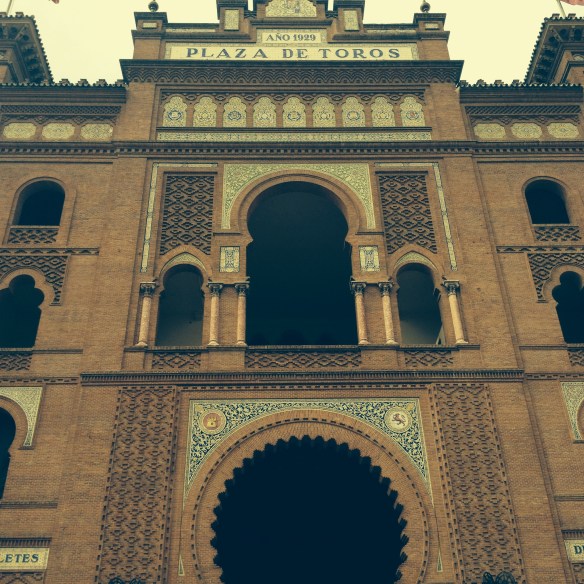
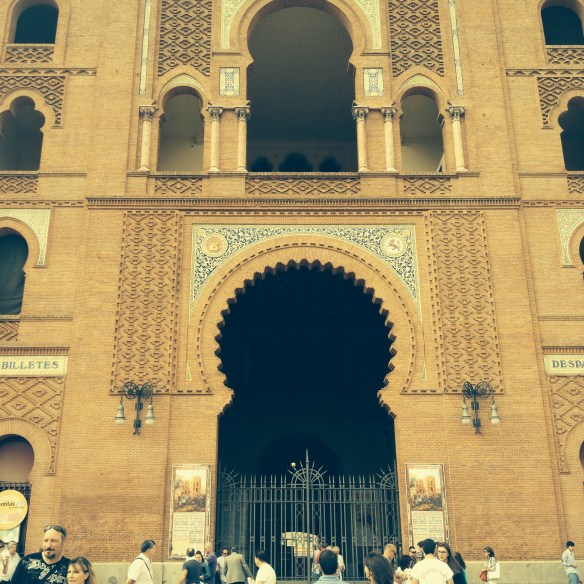
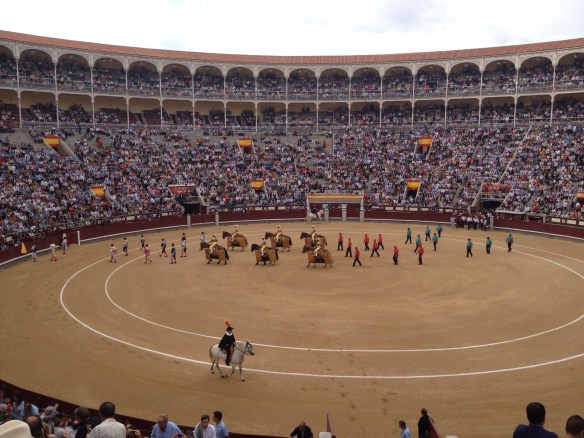
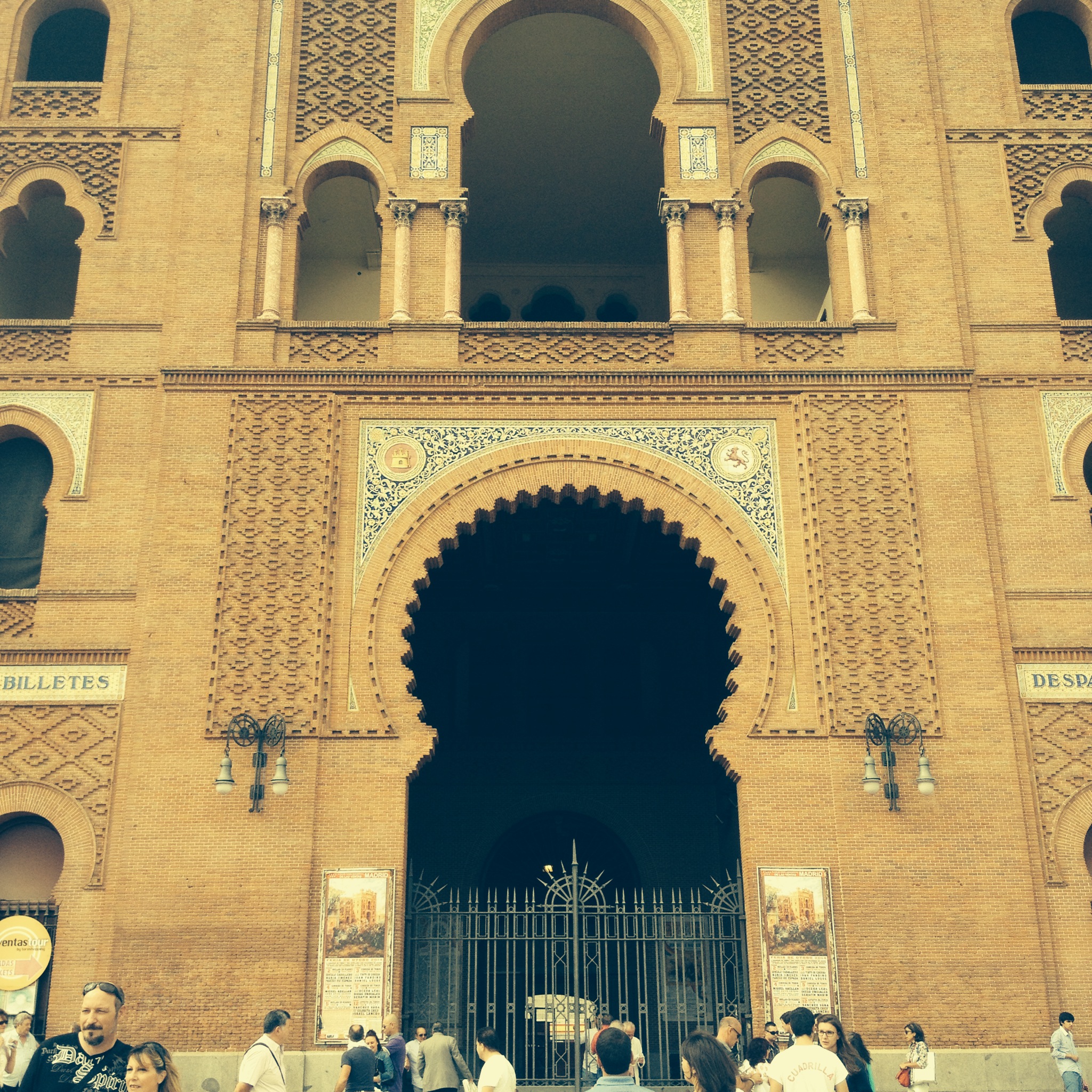
The Las Ventas bullring is stunning: a massive brick stadium, beautifully crafted with the rounded archways of Muslim architect so often seen here in Madrid. The wooden doors that lead into the stadium are an imposing 20 or 30 feet high, intricately carved and sporting equally impressive cast iron hinges. The whole building is awe-inspiring and disturbingly beautiful considering it’s purpose.
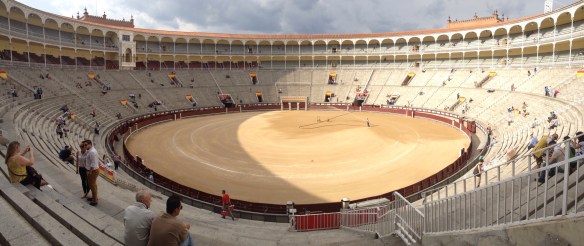
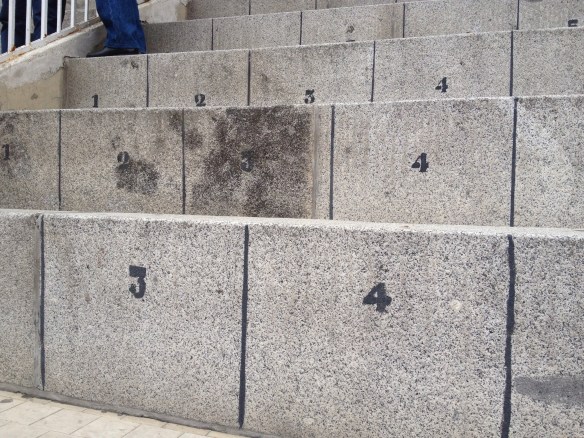
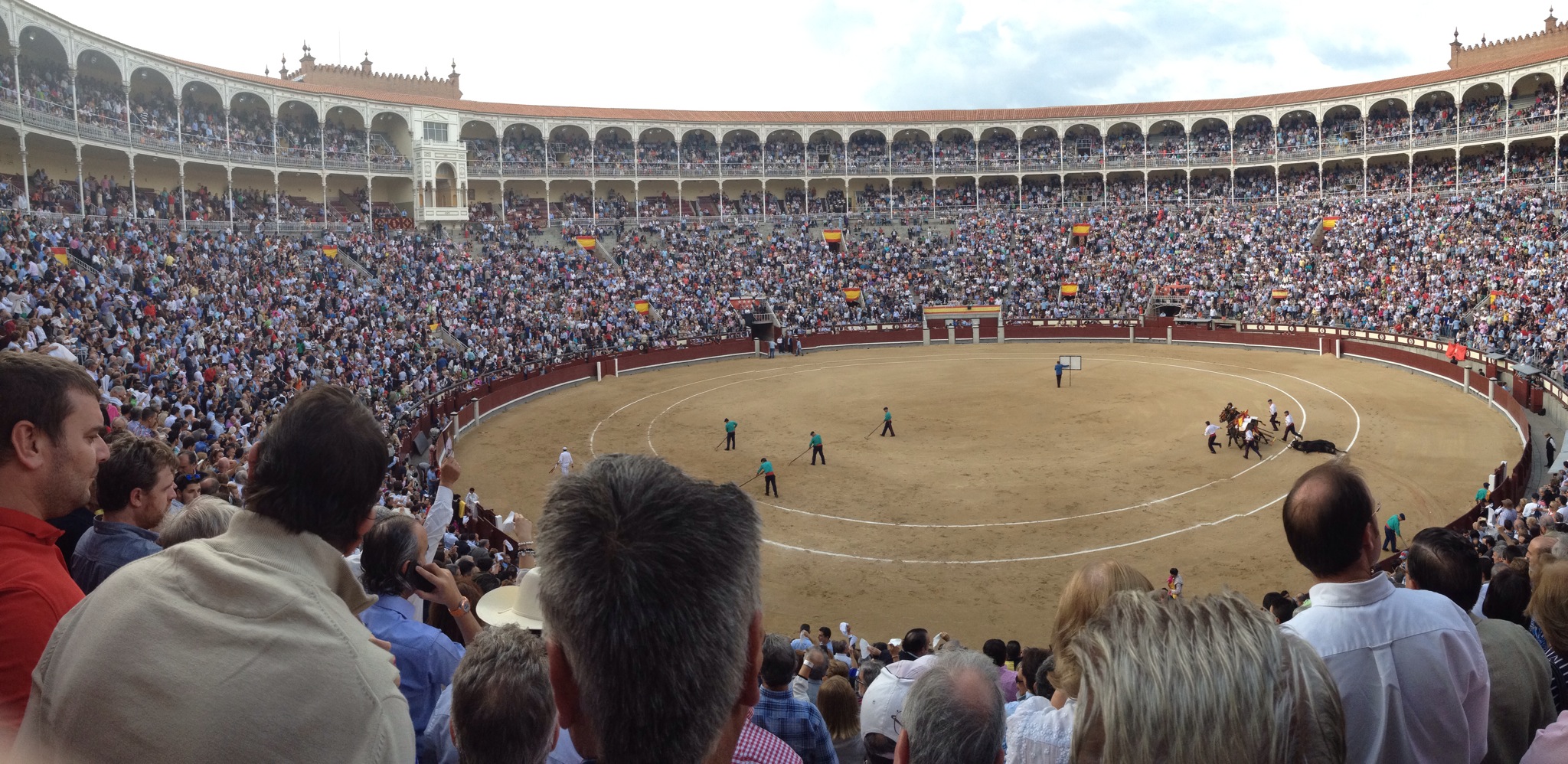
Inside the open-aired, circular stadium it is medieval. It’s like walking back in time 1000 years to a more primitive era: an ancient setting for an ancient sport. The stadium seats are long, rounded benches of concrete. They are so tightly crammed together that while sitting, a persons knees are pressed up against the back of the person in front. The benches are labelled with painted numbers, sprayed on the concrete to determine each seating space in the row. These are also so close together that, once the stadium has filled, there is no getting out from where you are placed. The arena floor is a large, sand covered circle. When we arrived, a man was spraying every inch of it down with water: perhaps to stop the sand from spraying into the matador’s eyes during the fight, or maybe for better footing, I’m not exactly sure. Either way, the stadium had a feeling of anticipation. Even before the crowds arrived, dressed in their finest, toting small children, and chatting amongst themselves in rapid Spanish, the arena had an aura of mixed excitement and death…
Now as a side note: I’m not a supporter of animal cruelty. I’ve had mixed feelings about telling people that I wanted to attend a bullfight in Spain. My announcement has received about 50/50 excited and slightly envious support and absolute appalling gasps, shaming my decision. I myself didn’t know how I would react at the fight either; I could just as easily love it as hate it. But my main reason for traveling is to experience new culture, in all it’s glory, the good, the bad and the ugly. So I booked myself a ticket.
I knew basically what a bullfight was about. I knew I was going to see a man stab a sword through a bull’s neck and I knew I was going to watch that animal die. But retrospectively, I think I had slightly different expectations about how it was all going to go down.
In my mind, I had seen the bull as an enemy: a feral beast, out for blood, ready to kill. Similarly, I saw the matador as a lone wolf. Half predator, half prey, standing alone in the middle of a sandy ring awaiting the beast. I could imagine his fear. I could feel his rushing blood and beating heart. I understood how the onlooking crowds would view him as a hero, the epitome of brave, the savior of us all. This was to be a one on one battle of wits. Equal chances for bull or man to die in front of thousands of cheering onlookers. Anything was possible. This was the bullfight I expected. In reality, it was much different.
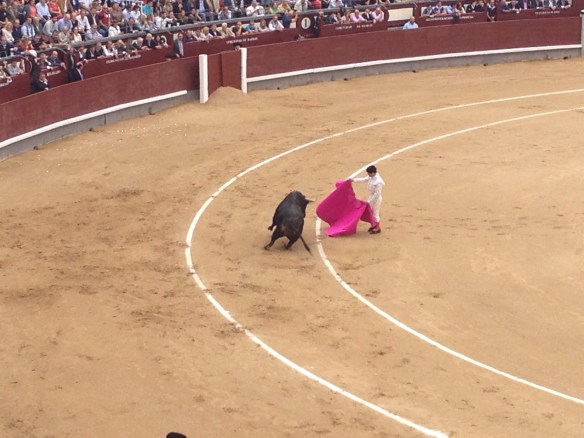
As soon as the bull entered the ring I knew I was going to hate every moment of bullfighting. This was not a wild enemy of man. This bull was a terrified animal. As it entered through the stadium door, it took one look at the thousands of onlookers and, in fear, tried to run back through the doors it had just come out. Upon finding them now closed, it edged a few steps inward and stood still, unsure of what to do. There was a moment of pause. A peone (a matador’s footman) stood off at one side of the ring with a large pink cape, waving it at the bull, provoking it to charge. The bull was uninterested. It didn’t want to fight the man. It wanted to get out of the ring. As the man moved slowly closer, yelling and waving, finally the bull rushed towards the peone. The man darted backwards, running like a coward behind a wall as the bull came toward him. Then a second peone appeared a little further away, leading the bull to another area of the arena. He too ducked behind a wall, confusing the bull until a third man appeared, taunting the animal with yells and waving capes. After a few minutes of this an armoured horse came out with a picadore (horseman) holding a speared lance in one hand. The bull fearfully backed away from the horse until the three peones cornered him into one side of the ring. The horse sided up along the confused bull, and the horseman jabbed the spear into the animal’s neck. The bull reared in pain, and tried to attack the horse. The horse however, was so heavily armoured that the attempt was frivolous. The bull, now bleeding from the neck, was then lead around the ring by the peones once again, before the horse came out for a second stabbing. Nothing about this was a fair fight. This was a ganging up on a confused animal, with four men, an armoured horse and a long lance. When this part of the fight was over, the next stage was the banderillos. Banderillos are flag men that run towards the bull with spears. When the bull puts it’s head down to charge, the men throw the spears into it’s neck. The floppy and colorful spears hang off the bull’s neck while the next banderillo makes his move. Then the peones come back to tire the bull out once more. When the bull is sufficiently tired, has four or five spears hanging out of its neck, and is losing blood at a rapid pace, it is then, and only then that the matador enters the ring.
The crowds go wild for the matador. Dressed in his traditional attire, a pure white suit with sparkling silver adornments, I thought he looked more like a Spanish Elvis impersonator than a gladiator. The matador strutted around the ring, bowing to the applauding crowd and walking in such a fashion that I actually forgot about the horror and laughed at how silly he looked. He displayed his bravado like a male peacock in a mating ritual as the bull heaved at the side of the ring, trying to catch his breath and find a way to escape the sounds.
Then the fight began.
The matador taunted the bull, who charged at his cape, perhaps out of anger, perhaps out of instinct, or perhaps for survival. Blood ran down his neck and sides, spears hung off his flanks, and the matador stood, waving his pink cape and holding his sword. I admit, the bull still had enough strength to manage a few close calls. At one or two points when the matador got really cocky and faced away from the animal as he plunged at him, I secretly hoped to see the bulls horns gorge the leg of the matador and drag his body in a defiant victory lap around the ring. But this never happened…
With each duck and turn the matador made, the crowds went wild! I’m not sure if there was some points system that was going on, or if close calls evoked more of a reaction, but people were literally at the edge of their seats in excited anticipation. It was a show, and to be fair, the matador took full advantage of the prolonged drama. He danced and dipped, he sliced at the side of the bull, and faked an almost kill for quite a while. But when the time was right, you could feel it. This was going to be the end. This drawn out torture of the confused and scared bull was finally about to be over. The crowd almost hushed as the bull took a final rush towards the smug matador. The matador took a step to the right and plunged his sword into the bull’s neck. So deep that the hilt of the sword was the only thing left to be seen.
But that wasn’t the end. The bull was still standing. It had no fight left, but it was still standing. The peones ran out and joined the matador in the ring, then edged the weary bull towards the side of the arena. The bull stood there for some time, staring at the four men in front of him. The crowds were yelling. Kelsey, Peter and I were staring in utter horror, wondering what was going to happen next. I’m sure it was only a couple minutes, but this stare down seemed to last for an hour. It was hard to see what the bull was doing from where we sat. At one point we thought it fell over, but then we saw it stagger towards the matador one more time. Then the matador was handed a second sword…
The matador held the second sword out in front of him and inched toward the bull, moving the blade closer to it’s head. Just as I thought he was going to push the sword into his neck again, he instead used the tip of his new sword to grab the hilt of the previous one. He then slowly pulled the first sword out of the bull’s neck. The bull teetered on his feet, took another step forward and then finally collapsed on the sand. The crowds were ecstatic. Everyone got to their feet and frantically waved white flags above their heads. Thousands upon thousands of white flags covered the stands in the arena. It was like watching the crowds go wild after a winning goal in a playoff hockey game. The matador bowed. More men and two more horses rushed onto the arena as people yelled their congratulations to the matador on his brave kill. The bulls body was hooked up to long chains attached to the horses, and then unceremoniously dragged across the length of the arena and back out the doors it whence came. And that was that.
Kelsi, Peter and I looked at each other and collectively decided that that was it for us. There’s no way we could watch another five bullfights in the following hours this went on. Along with the South African family sitting behind us, we pushed our way through the throngs of people to escape the stadium. The place was madness, and it took us several minutes to fight our way to the door. Meanwhile, the arena floor was raked, the bloody sand was covered up and the place was restored to normal. As we were walking out the doors I turned around to take a final look at the arena. The last thing I saw before I finally turned around for good was the second bull, thrust into the arena from the same door that the bloody corpse has just been dragged out. It looked around with a startled expression… And the crowds went wild.










 The Bucket Lust