The Salt Flats

DSCF3630

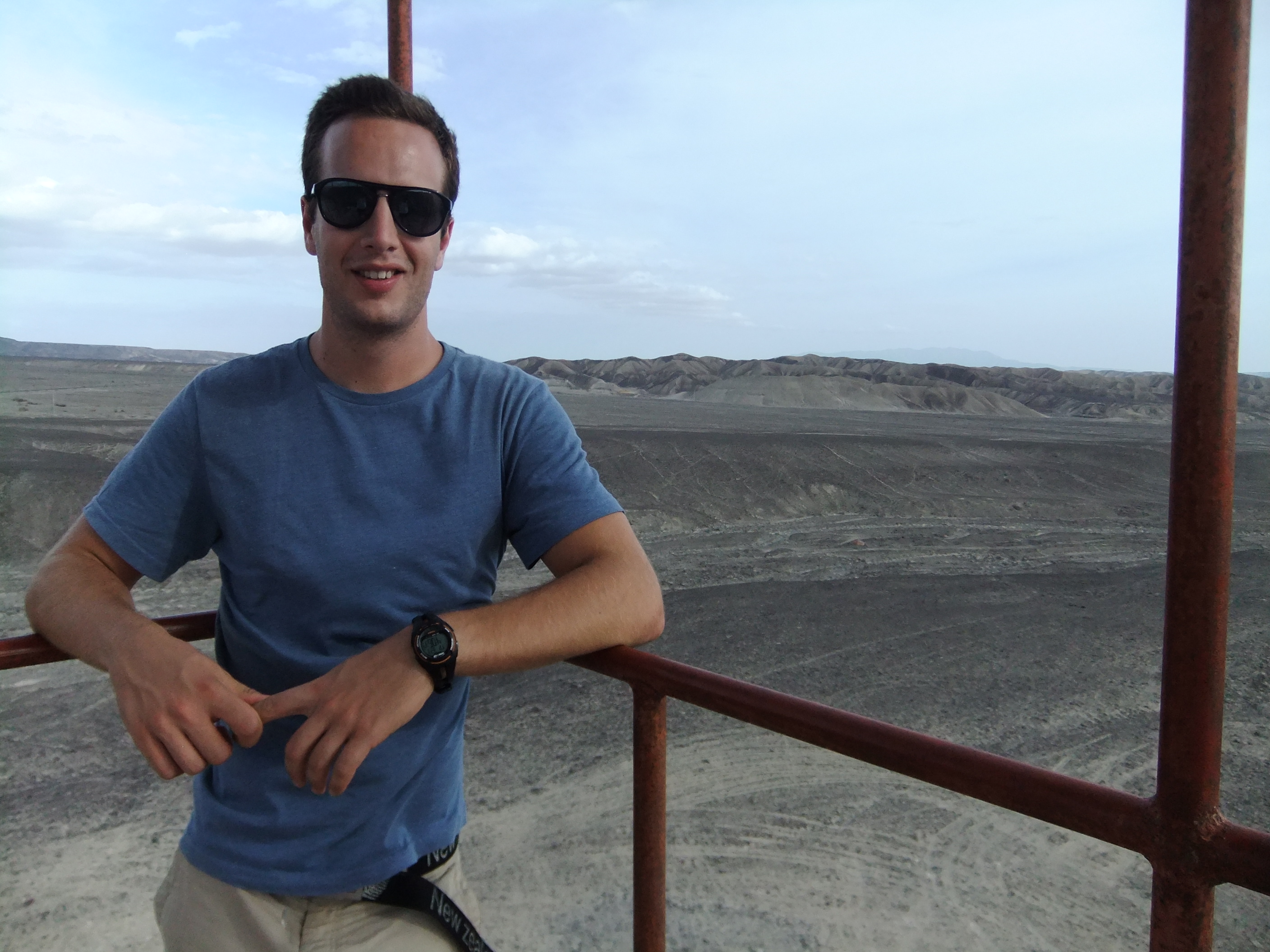
Adam and I have been excited about visiting the Salar de Uyuni since day 1 of our trip. Uyuni: home of the largest salt flats on Earth, where tourists love to take crazy photos of themselves in odd positions! Plus, we’d get to check off another world wonder at the same time. Glorious!  We had been writing a list, and collecting props, for our designated hour of photo taking for months now, and it was finally time to put our work into action!


The town of Uyuni is nothing special… And that may be giving it credit. It’s a couple blocks of dusty streets in the middle of a desert. The restaurants in town try to cater to every backpacker craving at once.  There were Italian restaurants boasting about their Mexican tacos and their wide selection of traditional Bolivian cuisine: pizzas, fried chicken, American breakfasts, pastas, and burritos, all served at the same tiny hole in the wall. And yet, after 3 days off-roading around the Bolivian countryside, Uyuni was the most appealing town we saw.

DSCF3610

Our tour began at 10am the morning after we arrived. We had a wonderful group of 6, from Brazil, Australia and Canada who got along famously. We all piled into our little 4X4, bags strapped to the roof, and headed out into the desert! 
Our first stop was the train cemetery. It’s exactly what it sounds like: a pile of old trains, rusted and no longer in use, stranded in the middle of the desert. The trains were originally British built and used to export minerals to the coast. The Bolivian government supported the railway, but the Indigenous people saw it as an intrusion on their lives and kept sabotaging the tracks. Eventually, the mining industry collapsed, and the trains were left to rust during the 1940’s. At first I didn’t realize why we had a whole 15 minutes to take photos of unused trains, until it became apparent that “train cemetery” is synonymous with “awesome adult playground”. We climbed the trains, got in the conductor’s booth, tried to lift all the heavy parts (read: Adam did) and lay down on the tracks like a damsel in distress (read: I did). 15 minutes and a whole bunch of fun photos later, we knew this was going to be a great tour.  So off to the salt flats we went.

DSCF3614DSCF3620DSCF3625

Driving towards the salt flats looks like you’re driving towards the edge of the sea. You can see it coming from kilometers away; it’s bright white colour reflecting the sky, making it look just like the ocean. The mountains on the other side of the Salar seem to hover in the sky. There is a strange gap between the ground and the base that make them appear as floating islands. Very surreal, and very beautiful. 
Originally we believed the salt flats were the result of a giant, salt-water lake evaporating… Turns out we were wrong. The flats are made from several prehistoric lakes, combining into layers of water and salt crust. The salt crust is anywhere between 10 centimeters and a few meters thick. Underneath the salt crust is a lake! The briny water ranges between 2 and 20 meters deep. There were even a couple breaks in the salt crust, that looked like ice holes for fishing, where you could clearly see the water beneath. The flats stretch for 10,582 square kilometers, making them BY FAR the largest in the world. They make up 70% of the world’s lithium reserves, and much of it is used for human consumption as well.

DSCF3632

Our driver set us loose to take photos while he cooked us a meal in the back of the 4X4. The 6 of us collaborated our ideas and took a plethora of silly photos. 
When lunch and photos were over, it was time to make the 3 hour drive to Chuvica village to spend the night.
DSCF3638SAM_3144SAM_3151SAM_3160

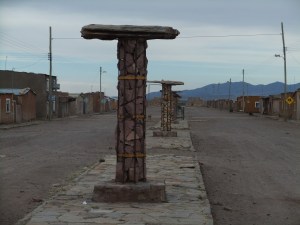
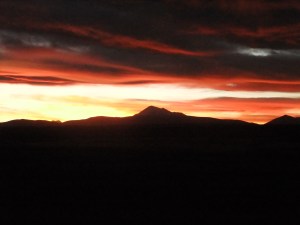
We sped over dirt roads, kicking up loads of dust behind us until we reached the village. The place was deserted. It was a tiny ghost town, in the middle of a brown desert, with only a couple little places for us tourists to stay. It was freezing cold as the sun dropped behind the mountains, and although there was a spectacular sunset, that was the only thing to see or do for the evening. We sat around our little table with hot tea and cookies and chatted until dinner. When dinner arrived we realized we were part of the reject group. We drooled at the hot plates and bottles of wine that arrived at the next table over. Breakfast was the same thing. Cakes, cereal, juice, yogurt, anything you could want, was all laid out on the table next to us… A crushing realization at 6:45 in the morning. But our makeshift runny egg sandwiches were definitely a delight!! And we shamelessly “borrowed” the remaining yogurt and fruit loops after our rival group departed. Class act!
DSCF3651DSCF3655

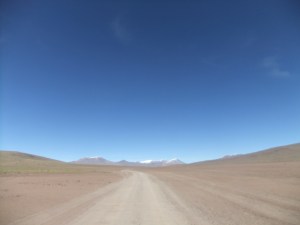
Day two was full of crazy sites and loads of driving. We set out on the road at 7:30 sharp, and continued into the icy morning. We had an uprising and commandeered the iPod dock from the driver. His choice of Latin pop music on day 1, was less than ideal to the six of us, so Raf plugged in his tunes and we trucked along to ACDC, Metallica and other, more appealing, road-trip artists. The rare bits of desert vegetation had long but passed by this point, and we didn’t see plant life again for 2 whole days. We treacherously drove over rocky paths, engulfed within a landscape that could have been on the moon! Rich, reddish-brown earth, sweeping hills that looked like they were painted in the distance, snow capped mountains and rocky valleys. This place had it all! Except plant life of course.

DSCF3686DSCF3675DSCF3711

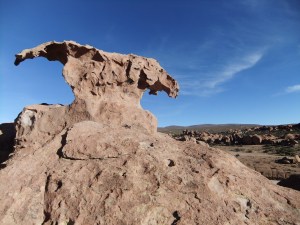
We first stopped in the valley of the rocks, where we spent another 15 minutes scrambling around the strange rock formations. Although none of us were really sure what caused these rocks to look so unique (much like the hoodoos of Alberta but less windswept and more jagged) we threw out theories like “glaciers!” and “wind!” like we had a clue. Our driver appeared to be much happier with his title of “driver” than that of “tour guide”. He didn’t speak English, but never explained anything in Spanish either, which left us to either speculate, or rely on the pre-downloaded Wikipedia pages that Mark and Oli provided.

DSCF3661DSCF3666

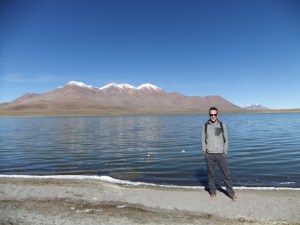
From there we cruised along to a few lagoons. To be honest, most of their names meld into one. Apart from the Laguna Verde, Blanca and Roja (which were Green, White and Red, respectively) the other names meant nothing to me. However, that didn’t stop each lagoon from being more spectacular than the last. The first one we came upon was a serene blue colour, with ice-capped mountains in the background. In fact, we were at such an altitude by that point, that even the lagoon itself had a thin crust of ice around the edge. The strangest thing about these freezing, high altitude lakes, were the myriad of flamingos that flocked around them! I’m standing there in 8 layers of clothing, kicking at ice, in the middle of a desert and listening to the unusual trills of the cooing flamingos! To me, flamingos belong in hot, tropical places; but here, they splash around in the icy water like it’s the greatest place on Earth! There are three different species of flamingos in the region: The Andean Flamingos (a grayer version), the Chilean Flamingo, and the rarer James Flamingo (which are the brightest pink). All of these types flocked around each of the lagoons we saw during the trip, and their strange cooing sounds could be heard across the valleys.
DSCF3674DSCF3693DSCF3687SAM_3182

From our first lagoon, we continued through the Siloli Desert, otherwise referred to as the desert of Salvador Dali. Dali’s surrealist paintings of desert scenes almost directly reflect the landscape of the Siloli Desert. At first I didn’t think much when our driver stopped on the side of the road for pictures, but as soon as he said the name Dali, I immediately understood. For a second you could even picture the bizarre, long-legged animals from his paintings just cruising across the horizon. The place really is spectacular!
DSCF3679

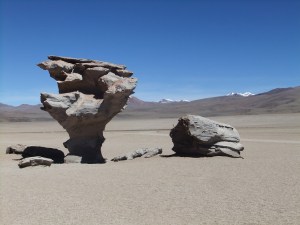
After we ate lunch out of the back of the van, we stopped at a place called “El Arbol de Piedra” or “the Stone Tree”. The only type of tree we’d seen in days, and it was made out of stone. It sat there, strange and seemingly out of place in the middle of the desert, but looked remarkably like a big, bushy tree. It’s amazing the thing hasn’t fallen over! A tiny base, expanding out into makeshift branches and foliage, the stone tree must be about 6m high! 
It was a quick stopover at the stone tree, then we continued to our final sight for the day: the red lagoon.
DSCF3724

No one was joking about the name; the red lagoon is a deep reddish-orange colour and stretches on for kilometers! (again, fully inhabited by trilling flamingos). Apparently the colour is caused by a copper sulfate that is found in the water. Once again, very little “touristic” information given on the lagoon. I believe there was something to do with Algae as well, but as I decided to procrastinate writing this blog, I have forgotten the details.  
Nevertheless, it was a short drive from the red lagoon to our overnight destination, Huayllajara. A town, much like the first, that had absolutely nothing to do. Although this one did have a place to buy cans of beer, it apparently traded that luxury for its ability to provide electricity. So we drank beer in the diminishing light until 6:30, when finally, the dim hall lights turned on for 3 hours while we ate dinner, and called it an early night for bed. Which was fine with us, as our wake up time was quarter to 5 in the morning.

SAM_3190

Let me tell you, quarter to five came too early after a sleepless night for us all. The dry climate and 4500ish meter altitude kept us all unable to breathe properly through the night. But we dragged our asses out of bed, early enough to still see the night sky all lit up with stars, and drove off into the darkness. First stop: the Geysers. At almost 5000m, the natural geysers and clay mud pots in the Sol de Mañana volcano were pretty neat. The sunlight was just getting ready to peak over the mountain, but the giant vents of steam that shot out of the ground were clearly visible, even before sunrise. Once again, no safety standards. Big surprise. Please feel free to walk through the dark, along the slippery mud, right up to the edge of the lava filled hole with shooting steam, all you’d like! You could clearly hear the sucking and sloshing, of what I’m assuming was lava, below: although I was confused that there was no heat, or red glow, like the lava that can be seen in other volcanoes. In fact, it was freezing out! There was no heat whatsoever. I immediately regretted wearing flip-flops and it didn’t take long before I jumped back into the jeep, shivering.

DSCF3740

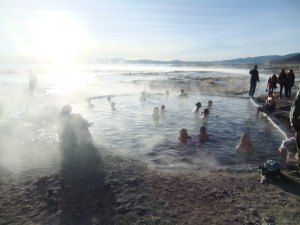
We watched the sunrise while we drove through the desert on our way to breakfast. At our breakfast stop was a natural hot springs that we had about a half hour to lounge around in. The temperature outside was insanely cold, and after getting into the water there was no way I wanted to face the outside world again! But it was a pretty spectacular view from the springs. You could stare through the steam, out towards a lake and the still rising sun off in the horizon. Not too bad a morning if you ask me!
DSCF3751

When we’d finished with breakfast, we drove onwards to the Green Lagoon. Not as green as the red lagoon was red, but the lake was still spectacular! The mountains in the background looked like a watercolor painting, and the lake was so still that it created a perfect reflection. This was sadly our last stop before the border into Chile. It was time to say goodbye to our Brazilian friends “The Raf’s” and work our way into San Pedro de Atacama. 
The Uyuni tour was incredibly fantastic, and I’m so thankful we had time to do the three-day trek over the one day. The extraterrestrial landscape of Southern Bolivia is unlike anything else we’ve seen in South America yet. Just another spectacular adventure to tick off the list!

DSCF3760

The Miners of Potosi

SAM_3070

Food Poisoning: the two words that pretty much sum up my last few days in Bolivia.  A failed attempt to visit hot springs in a nothing hole called Oruro (This place rivals Cambodia’s town of Strung Treng for places with nothing to do: minus the garbage market and the matching pajamas) I ended up on an overnight bus to Sucre with screaming babies, NO bathroom and food poisoning… I destroyed several bathrooms in a hostel with no functioning water system during the day, spent two full days in bed, and have nothing worthy to report on the otherwise aesthetically pleasing capital city.  Then, we worked our way to Potosi.


Potosi is the highest city in the world (with a population over 100 000) at an elevation of 4060m above sea level. The altitude is so intense, that just walking one block at a slight incline left both of us breathless. One girl we met said she nearly passed out brushing her hair one morning! We’ve been at a lot of high elevation in Bolivia, but Potosi is where I really noticed the physical difficulties.


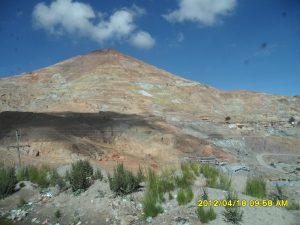
The city is really quite beautiful. Settled in brown hills with very little vegetation, Potosi’s streets are colourful and quaint! The place has gorgeous stone churches that light up at night, and funky pubs that cater to tourists with excellent cuisine. But what Potosi is really known for is it’s mining industry.  Potosi’s mountains are full of minerals including tin, iron and lots of silver; thus resulting in huge mining cooperatives. Anyone in Potosi can get a job in the mines; in fact, it’s a hugely family oriented career. Parents pass down mining techniques and knowledge to their sons and grandsons for generations, working long, hard hours for their wages. The men get paid according to how many tonnes of the minerals they can produce… But at the end of the day, the wage is middle class at best, and the work seems hardly worth it.

SAM_3072

Adam and I went on a tour of one of the mines and found the experience to be eye-opening. We suited up in full rubber boots, work pants, a jacket and a helmet with a large headlamp and set out from our hostel. 
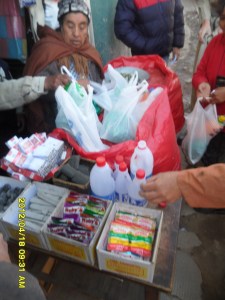
Our first stop was the miner’s market. This is where we bought gifts for the miners we were going to see during the day. We each bought juice and coca leaves, but it was also possible to purchase gloves, clove cigarettes, a moonshine-like alcohol of 98% liquor or dynamite.

SAM_3065

Once we had bought our gifts, we drove onwards towards the mine. 
The mine that we went to had been in operation since the 1700’s; and I’m pretty sure still had the same safety regulations as when it first opened. Today, there are 150 men working in that particular mine, but there are over 500 separate mines in the one mountain. The men work in small teams, or individually within the mine: each collecting his own profit and or splitting it among the group of 4 or 5. Their workday is minimum 8 hours a day, 6 days a week: although often some men work up to 12 hours a day. The work is tough to say the least. Long hours of heavy labour with no food or sunlight all day long. The only thing the men consume while on duty is coca leaves and juice. Food is said to be bad for the digestive system down in the mines because of the amount of dust that is around. Some men chew so many coca leaves that they have permanently stained black teeth, and have large, permanent lumps on the side of their face from where they’ve had coca stored for so many years.

DSCF3604SAM_3080

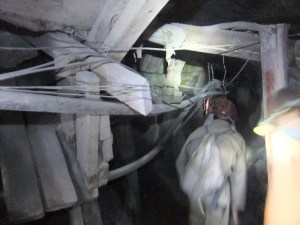
We walked as a group into the entrance of the mine to begin our two-hour decent. The entrance tunnel was dark, dusty, and filled with ankle-deep water most of the way. You had to hunch over to be able to walk, and electrical wires and oxygen tubes ran along the ceiling of the tunnel. You could constantly hear dripping water and leaking oxygen as you walked along, and frequently we would all have to press ourselves against the cold rock walls to let men with carts speed past along makeshift rails. 
This mine went down 4 different levels, and men worked on all of them.

DSCF3595

We began our tour by descending to the 3rd level and talking with 2 miners. One was named “Jimmy Morrison” and the other was his eldest son. 
It was immediately apparent that there was no easy way down the levels. We scrambled through tiny holes that were barely large enough for a body, crawled through short tunnels, and traversed our way down the side of a rock wall with only a rope to hold on to (the rope was only used for tourists, the miners apparently just scamper their way around effortlessly without). At the bottom, we briefly chatted with Jimmy Morrison’s son. He was a twenty-year-old kid who had diligently worked along side his father in the mines for the past 5 years! Since he was 15, he’d spent minimum 48 hours a week, down in the mines, chewing on coca and digging away for silver and tin. By 20, he was an expert in setting up dynamite explosions, and extracting minerals with small hand tools. This boy looked way beyond his years. Although he was very shy, I never would have guessed that he was only 20 by the way he talked about his job and moved about the mines. It was incredible, and kind of sad, knowing that he was destined to a life of darkness at such a young age. We gave him a large bottle of peach juice and a bag of coca leaves and let him continue with his work. There’s no money made in taking breaks in this trade…

SAM_3090DSCF3591

So we continued exploring the mines, our adorable little female guide leading the way effortlessly through the maze of tunnels. We arrived in a cavern with a large, rock statue with horns, which was covered with small offerings. This was the god of the miners: Satan. 
Because the miners work underground, where there is no light, they worship the devil so that he will protect them in his realm of the underworld. The statue was creepy to say the least, with a snarling face, painted red, large horns, sitting in the darkness on a ledge in a cave. The effigy was covered in small offerings from the miners. Coca leaves, cigarettes, small bottles of alcohol and such covered the statue from head to toe. As well, little colourful flags were found covering the devil, and the room that we were sitting in. The flags were from Carnival. Every year the miners celebrate Carnival, just like the rest of South America. But they do it at work! They dance, bring booze and decorate their workspace with colourful flags for the day to celebrate! Even the tourists that come on that day join in with the festivities, and party alongside the miners.

SAM_3094

After we stared down the hardened face of the devil for a while, we continued upwards, and deeper into the mine to visit an old man named Pablo, who had worked in the mines for 36 years. 
We squeezed our way through tiny openings, scrambled upwards, practically digging our fingernails into the dirt walls to shimmy along, and made it to a larger opening a few stories up. There we found Pablo, a huge and jolly miner digging away with his bare hands in a tiny hole that he’d been working on for god knows how long. How this man fit through the holes we had just squeezed through is beyond me! But he was nice enough to take a break, sit down, and talk to us about his life as a miner.


Pablo came from a long line of miners. His father was a miner, his grandfather was a miner, and his great grandfather was a miner. Pablo himself had 10 children, 5 girls and 5 boys, and 2 of his sons worked with him in the mines while the rest went to university to learn other trades. Pablo is 51 years old and has been working in the same mine since he was 15 years old. He really enjoys it! He says it’s a great job for families. Sometimes, when his sons have a day off at school they come to visit him in the mines while he works. They get to catch up on life while he works. It’s mindless work at times, with just a lot of digging to do, so it’s nice to be able to keep up to date with your children’s lives at the same time. They tell stories while he listens and digs; he almost makes it sound idyllic…


But then Pablo reveals the sadder aspects of his job. In the 1970’s they did a count of every man that worked in the mine. There were 200, ranging from the age of 15 and upward. Pablo and his father had worked there then, and were included in the list. These were all people he knew, worked in close proximity with, was friends with some of them. Today, if you look at that same list, only 3 of those men are alive. Pablo revealed this with tears in his eyes as he recalled how each one of his family members and friends had passed away, too young for their years, from some sort of lung cancer, disease or illness as a result of their jobs. At 51, Pablo is an old man for the mines. He wants to retire soon, but his chances of living that much longer are slim anyways. 36 years of inhaling dust and grime and working unprotected around chemicals, explosives and dangerous minerals will take its toll on a body. Luckily, he still gets to spend quality time with his family while he can…. I suppose all jobs have their ups and downs.


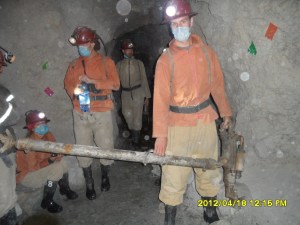
Mostly, Pablo works by hand, or with a drilling tool that he managed to acquire over his years in the mines. To make a 1 and a half meter hole by hand takes 1 month. To make that same hole with the hand held drilling tool takes 1 hour. Big difference; however, to rent the machine for one hour is equal to over 1 day’s wage. So for some people this luxury is impossible. The average mining wage is 100 Boliviano’s/ day, or $12CAD. It is $15/hour to rent the machine, and even that is a low-end, hand held device that would be sub par standards around the world. Some men we saw in the mines have newer, more efficient machinery to work with, but mostly those men work together as a team and are able to split the costs. Pablo still uses more traditional techniques, and carries the 75kilo, several feet long, drilling machine into and out of the mine everyday himself. Through snaking tunnels and tiny enclosures: trust me, this seems a nearly impossible feat when you see these tunnels!!

SAM_3100

After we all chatted with Pablo it was time to go. We also gave him a portion of our gifts, then headed on our trek out of the mines. Just two hours, trapped in the dusty enclosure of the mines was quite the experience. To see how these men work so hard, everyday, to support their families, even though they understand the consequences of their job, is incredible. The safety standards are completely non-existent, with men wearing jeans and t-shirts into the mine with no safety masks or protection from dust whatsoever. It’s amazing, saddening, and a way of life that I just have to accept I suppose.  
It was a whirlwind morning in Potosi to say the least. We were out for a nice dinner that evening and onwards to Uyuni the next morning! Three days of trekking in a 4X4 in the South of Bolivia still to come…

DSCF3599SAM_3097SAM_3095

Death Road: Bolivia

Just outside of La Paz exists the world’s most dangerous road. Now titled “Death Road” from the number of people that have died driving on it, this highway used to be the ONLY means of transport between La Paz and a good chunk of the rest of Bolivia. Finally, a 15-year project was launched to build a new, very much longer, but very much safer highway (if you could really call it a highway). Before the new road, about 26 vehicles tumbled over the edge and down the massive, vertical drop each year: very much deserving it’s “Death Road” moniker.


I first saw clips of The World’s Most Dangerous Road (WMDR) in the Top Gear “Bolivia Special” episode and have been having heart palpitations about it ever since. When Adam told me he wanted to mountain bike down it I laughed. I said “Nope, not me, I’ll wait for you at the bottom in a cozy cafe, you crazy SOB”.  Obviously that’s not what happened.


Okay, so you need to know one thing. I HATE biking. I loathe it! I don’t like cycling down a flat, perfectly paved street; I don’t like rocketing through trees downhill on a mountain bike; honestly, I don’t even like the stationary bike at the gym, it’s my NEMESIS. So I definitely don’t know why I thought I was going to enjoy biking down the WMDR in a third world country… But that’s what I signed up for.
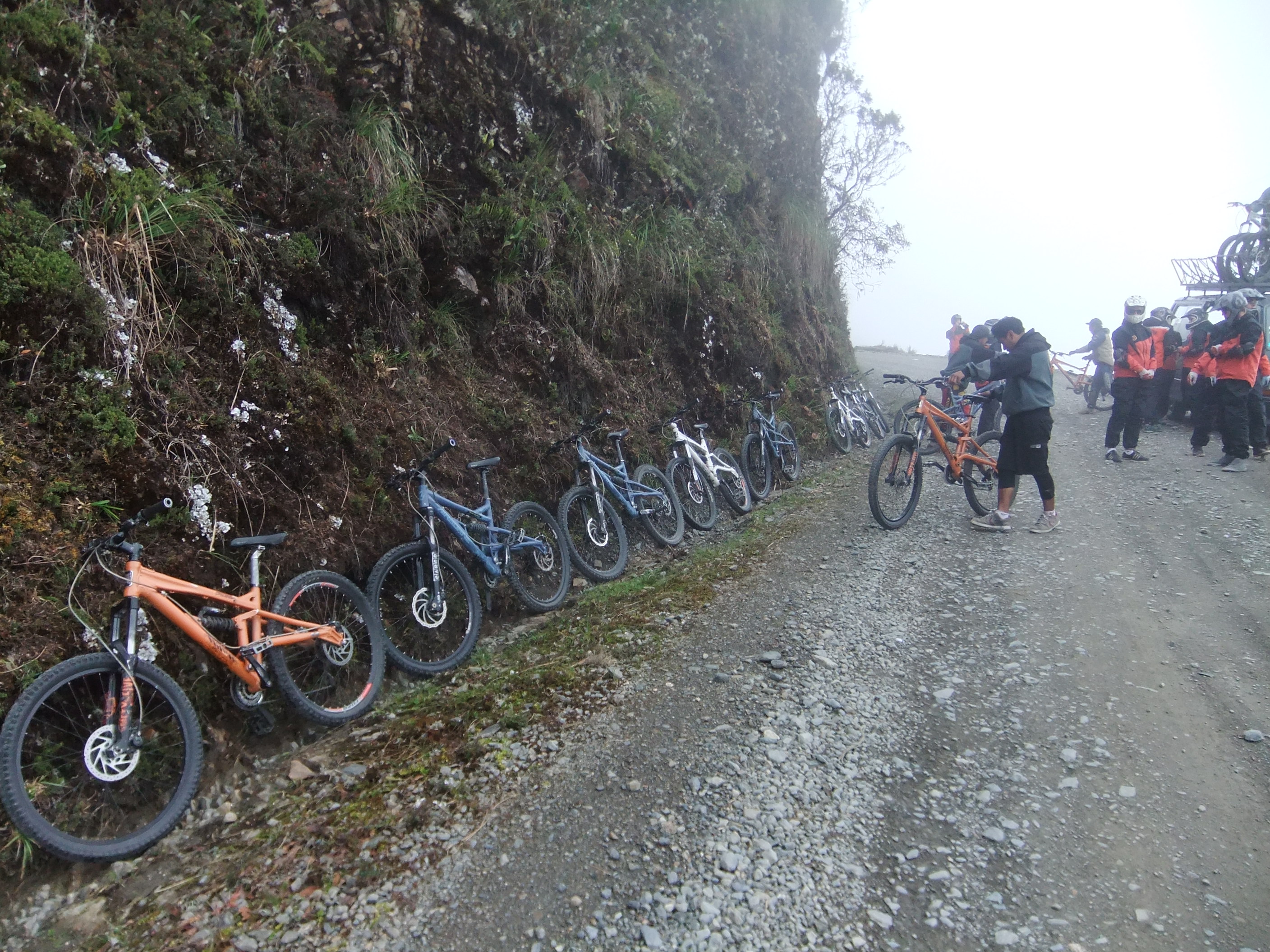
  The actual bike ride is between La Cumbre and a small town called Corioco. It is a 64km journey and a 3600m vertical descent, total time: 5 hours.

Our mini bus pulled up to La Cumbre just after 9am. It was breathtaking… As in, the altitude was so high it was difficult to breathe. Well, the 4600m, combined with the brisk early morning air and the idea that I was about to be rocketing 3600m downwards left me a little breathless. But also, there was a VERY beautiful lake, surrounded by what appeared to be very low, snow-capped mountains, but which were probably close to 6000m in altitude. We all put on our gear: elbow and knee pads, helmets, gloves, thick jackets and pants: the whole works. Although I was significantly warmer, I couldn’t help but thinking that NONE of this will be relevant if I go skidding off a cliff. Since the WMDR has opened to bikers, 15 have died… And I’m sure they were wearing just as much gear!
  Nonetheless, we started our decent!

The first part was 32km of paved road with absolutely unbelievable views of the mountain range. The scenery was exquisite, and every time I try to describe the landscape here in South America I feel at a loss for words because everything is so larger than life and amazing. Death Road was no exception! Endless mountains, deep passes, green brush, rocky cliffs, and waterfalls all throughout… Oh yeah, and a windy road right in the center of it.

I actually enjoyed the first 32 kms (Shocking, I know. Don’t worry it doesn’t last long). I didn’t have to move a muscle; the downhill part kept me gliding onwards, then I would occasionally use my hand breaks when I needed to slow down, or pass a truck. I didn’t feel 100% confident on the bike, but if this was Death Road, then NO PROBLEMO SEÑOR! The 32km went by VERY fast. With all our photo stops and re-grouping to catch up it took us about an hour and 20minutes.


Afterwards, we stopped for a snack of sandwiches and cookies. Then our guide announced we were jumping back in the van. My heart leapt a little as I thought this might be the end. Unfortunately he continued with “then we’ll drive you all to Death Road”. What? That wasn’t it?! 
That’s when I started looking at the photos of the people on the map he gave us. Pictures of people biking over huge rocks, gravel roads, through waterfalls… Awesome, I’m going to be wet at the end of the day too! (Another pet peeve of mine.  Just try to get me on a water ride at Disney Land). Okay, I’m a little more adventurous than I’m making myself out to be, but I’m pessimistic about biking all day… And this is how I felt at the time.

So our van pulls up on the start of death road and I’m pretty sure we’re all going to be part of next year’s stats for vehicles plummeting over the edge. Our driver backs up RIGHT to the edge of the cliff, so it’s possible for another vehicle to pass if needed, and leaves the whole left side of the van practically dangling over the edge. The German girl in front of me screams, I most likely went white and froze; who knows, I’ve blocked it from my memory (and I’m not even afraid of heights!). This was something out of my control.  For once I actually wished I was on my bike. At least I have control of that vehicle and don’t have to leave it up to the skills of our Bolivian driver.


View from the window as we parked

So our guide gives us all the safety rules of the road. How to pass other bikers (haha, as if I needed to know that), how to deal with oncoming traffic (not that there are many vehicles on the road, but we did encounter a few) and how to properly use a bike (something I actually know how to do, god help anyone who comes on this trip trying to LEARN how to bike). 
So we set out, and I’m doing fine. I’m not a show off, so unlike Adam, I don’t feel the need to be at the head of the pack. I took my time and was not hating the experience like I thought I would.

The views were awesome, and because the road was rocky and steep, I pretty much rode my breaks for the next 28 kilometers: not good for the bike, but better for my sanity. After we stopped about three times for photo ops is when my hands started to hurt. I rode tensed up, trying to stop the shocks going through my body as I hurled over the rocky road. My hands couldn’t grip anymore they were so sore. Every time I tried to slow myself, my hands started shaking as if they were going to give out. My shoulders and neck were aching, and I stopped enjoying myself. I had NO PROBLEM with the height, OR the fact that I was on the WMDR. In fact, I forgot I was even in Bolivia! The dangerous road part had ZERO effect. I simply hate biking. I don’t like jolting over uneven rocks and skidding on scree and overusing my breaks, or going too fast.

Luckily, I managed to do some soul searching on the trip and realized where my unprovoked hate of the sport began. Turns out, when I was little, I went mountain biking through Mount Seymore parkway (either with school or Guides or something), and, down a steep, rocky hill, my breaks gave out and I had to cause myself to fall at the bottom of the hill before flying off the edge of the road and over a small cliff. I had entirely forgotten about this episode from my childhood until I was bouncing down similar terrain on this Deadly Highway… See, at least something positive came out of the trip!
 Anyways, point being, as soon as my muscles hurt I wished the trip would end. But it didn’t. It still took 3 and a half hours to complete!  But enough complaining.


Although I missed a lot of the scenery because I was watching the road so intently, our guides took photos for us and I’m sure they’re amazing! 
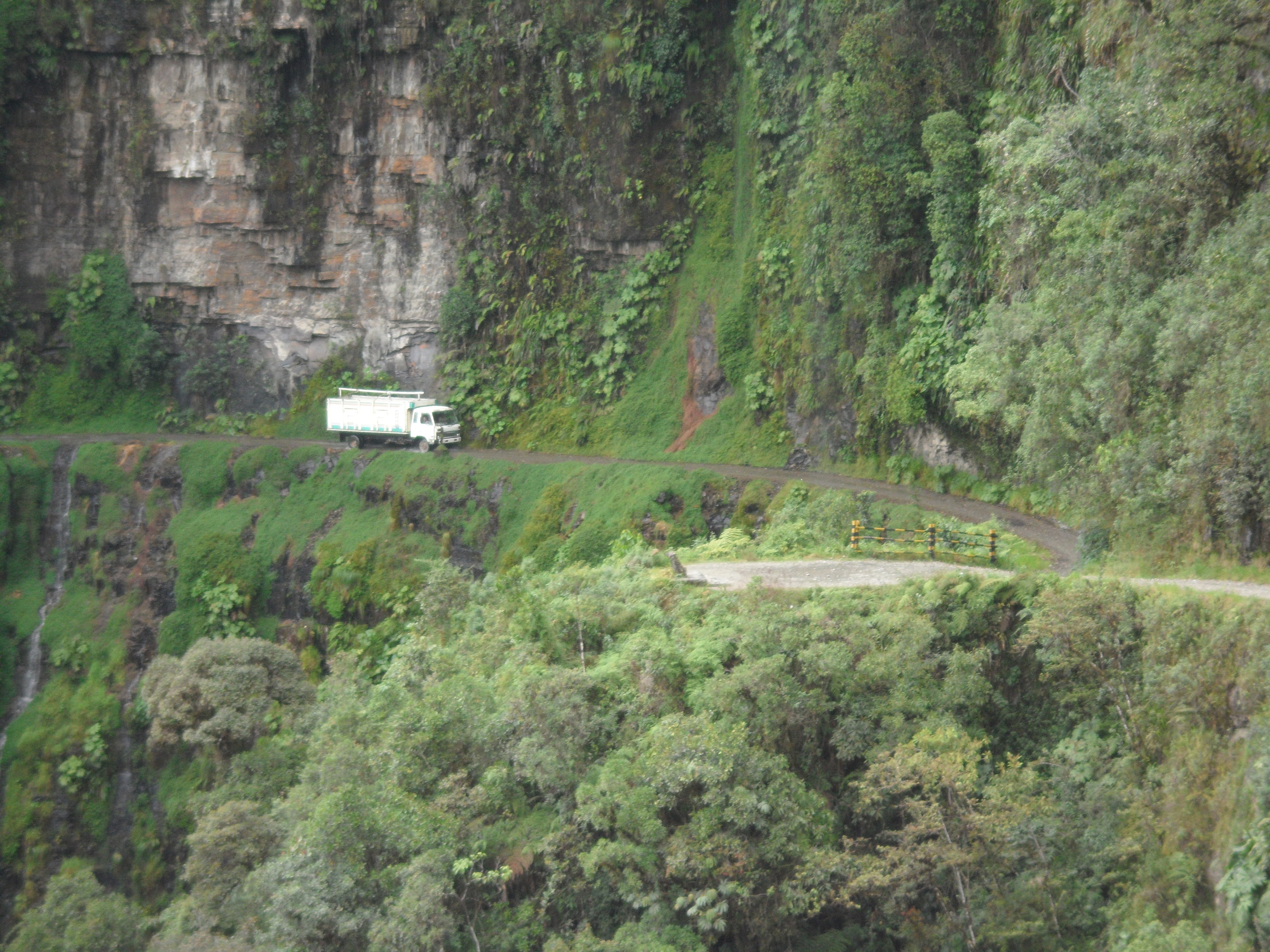
What I find the MOST amazing is HOW IN THE HELL this used to be a functioning road! A TWO-way road at that! During one of our stops, Adam and I watched a truck drive up a good section of the road from across a pass. We saw the truck, speeding along like he’d done this a million times with no care in the world. It was like a scene out of a movie, where a bus speeds down a highway and doesn’t realize the bridge is out ahead, but the whole audience is aware. Of course the bridge wasn’t out ahead, but around one of the corners the road got VERY narrow, and had absolutely zero rails, barriers, nothing whatsoever between the edge of the road, and impending death!


We stood, shell-shocked and horrified as the truck moved along the road, taking corners at speeds faster than I would allow my bike, until finally he came around the corner where the road narrowed. We, like disgusting tourists, had our cameras out trying to take photos as he flew around the corner. Then, just like that, he continued at the same speed like nothing happened; just as if the road hadn’t HALFED and his right wheels weren’t half on and half off the cliff! He just trucked on around the bends, through a couple waterfalls that left the road wet and slippery, and back onto the wider area (even the wider areas were no more than a truck width at best). I couldn’t believe it. No hesitation. Just like he was driving through a desert on a straight road. I nearly fainted watching him!

3 and a half hours later, we arrived in Corioco for a shower and a buffet lunch. The second we arrived I thought, “that wasn’t that bad”. But then I remembered how sore my hands and neck were and just shut up. 
For those of you who are wondering, Adam absolutely loved it!  So has every single person I’ve talked to that’s done it. Don’t let my hatred for bikes deter you from going should you find yourself in Bolivia one day. I’m sure the views are worth it!

Adam said he had a blast the entire way down, despite his showing off and falling not once, but TWICE on the trail. He’s okay, not to worry, just boy wounds and a ripped shirt. One of his falls was right at the end, and then after he recovered, he stopped to help an older lady who fell as well. That allowed enough time for me to pass him and finish earlier… Which, whenever he jokes about how bad of a biker I am, I rub in his face that I finished the WMDR before him. Muahaha! It’s the little things.

All in all, despite how much of a princess I’ve made myself appear in this post, I’m glad I did it. I can successfully say “I Survived Death Road”. It’s a story for sure, and we all know my old motto, “do it for the story”.   
Well here’s another I’ll never forget…

Playoffs in La Paz

So there we were… Adam and I, with our arms thrown around three other Canadian guys (and a guy from Seattle which we figured was close enough), crammed in the upstairs bar of the Wild Rover in La Paz, shouting “Oh Canada” at the Television screen in a deafening screech. Playoff Time… Happy hour was over, we’d been streaming hockey onto the pub television for 3 hours now as we watched the Flyers beat the Penguins: I’m not going to sugar coat it, we had been drinking.


I don’t think La Paz realized that hockey Playoffs would have been such a draw to their pubs; perhaps if they had, I wouldn’t have had to threaten the bartender’s life when he refused to play the Canucks game. In the end, he weighed his options and streamed the game. Good man. 
Sadly, and I mean sadly from the bottom of my heart, we all know how this game ended. What you don’t know, is how we ended up watching hockey in La Paz. So here you go…


Three days earlier…


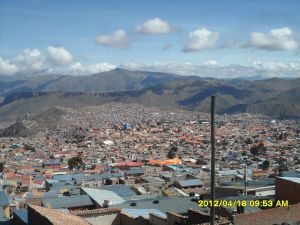
After a 5-hour, incredibly sickening, bus ride from Copacabana, we arrived in La Paz and had a fairly uneventful evening. It was Easter Sunday morning when we finally started exploring the city. La Paz is huge. It only has a population of 1.5 million people, but the way that the city is built within a canyon, all houses clinging precariously to the steep edges, makes it dizzyingly large. The upside to this city planning is, there is only one major street in La Paz, “Av 16 de Julio”, and it is at the deepest point in valley. If you ever get lost, just walk downhill and you’re right back on track!


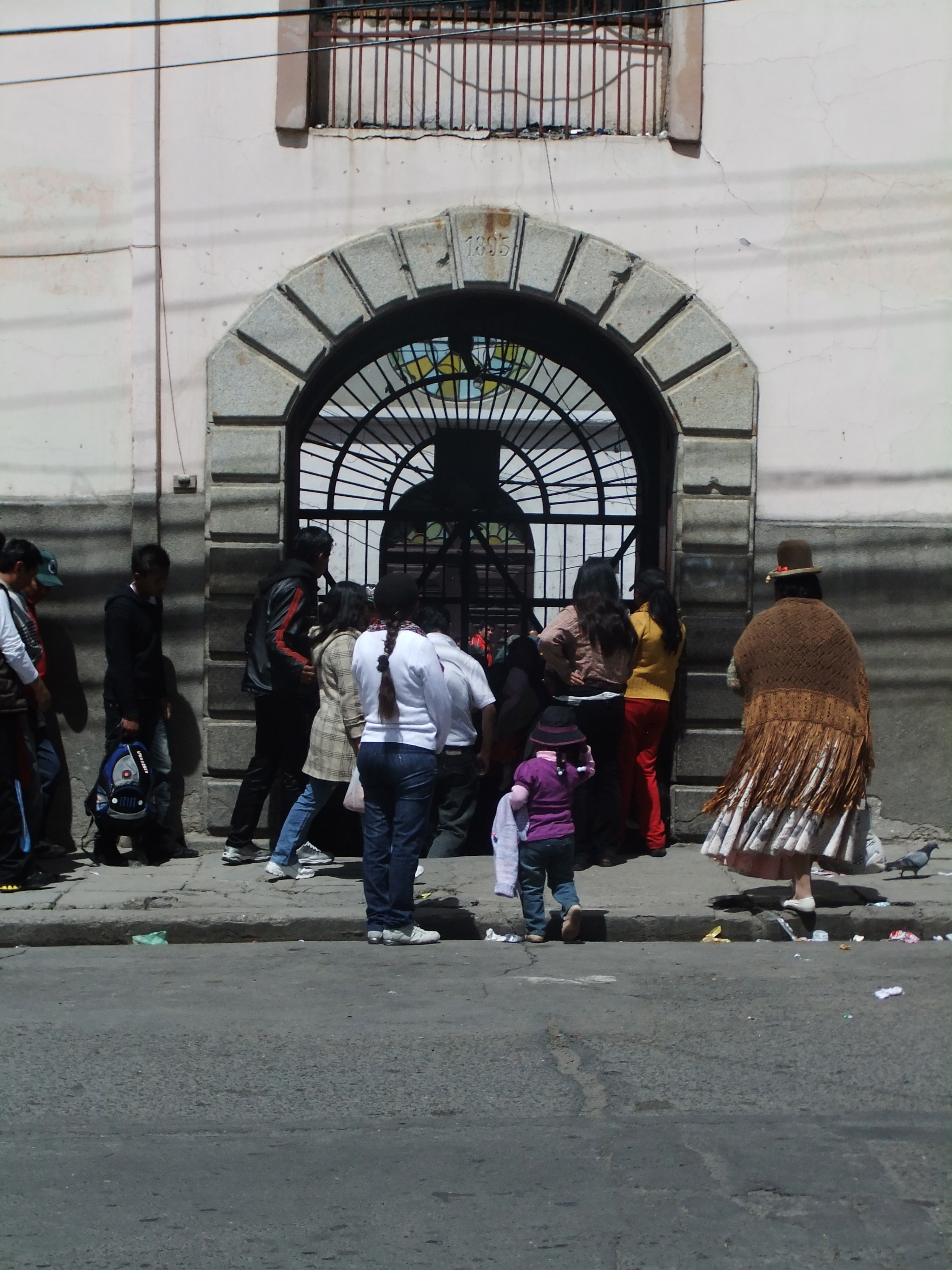
We spent the entire day walking through La Paz’s many districts. We started off at the infamous San Pedro prison in the San Pedro district. This place is unbelievable. For those of you who have read Rusty Young’s novel “Marching Powder”, a true story on one man’s life in San Pedro, you’ll know what I’m talking about. For those who haven’t, I hardly know how to explain. The prison has no guards once inside the outer walls, inmates are left to defend themselves and work out their own system of government. They have shops, restaurants, and APARTMENTS, in various “neighborhoods” throughout the jail: all run and operated by the inmates. Many of the inmates’ wives and children live with them in the prison (but are free to come and go as they please) and they drink and party and do drugs as freely as if they were on the outside. In fact, the best and purest cocaine in the world is manufactured within the walls of San Pedro: hard to believe. Up until a few years ago, they used to host tours for tourists to go inside, for a small fee, and see the workings of the prison themselves. The prison tour was even a must-do in the Lonely Planet guide one year. Unfortunately, since the “tour guide” of the prison was released, they have stopped all tourist access. So all we got to do was take a couple sneaky photos outside (which they frown upon now) and watch the going ons from the plaza outside. Being Easter Sunday, there was a huge lineup outside the main gates of the prison. From the plaza, you could see right inside the prison gates to the main courtyard inside. People had already set up for a huge party and you could see the inmates greeting their friends and family as they arrived. Very unusual rules here in Bolivia…

So we continued along our self-proclaimed city tour and headed East. Only 10 blocks or so from the prison, in the Rosario district, are numerous small shops, all lined down one or two streets, this is considered the “witches market”. They sell some very odd looking things. 
The “witches” are really just Bolivian women all dressed up in traditional garb. The clothing is similar to Peruvian, BUT, the Bolivians do sport a new hat! Bolivia’s hat fashion statement is the bowler cap! This is similar, and yet dramatically different, to the Ecuadorian fedora and the Peruvian “Robin Hood” style hat (These things are very important, you know, just in case you’re not quite sure what country you’re in).  
Anyways, the witches market sold everything from herbs, special healing elixirs in glass bottles, souvenirs, stone statues and even dried llama foetuses… Yes, that’s right, dried llama foetuses.  They were disgusting, bony, sometimes even hairy creatures, that we at first thought were shrunken llamas (not sure how you would shrink a llama, but I assume the Bolivians could figure it out if they wanted).


From the witches market, stems the “regular” market. Here there are endless streets full of a designated theme. A whole block full of electronics, or jeans, or shoes, bath products, snacks, fresh vegetables… You name it, it’s SOMEWHERE wrapped up in the maze of streets that makes up La Paz’s market area. It was exhausting. For someone who loves markets it was exhausting!  Needless to say, it was time to head home.


For our very special Easter Sunday dinner, we decided to go to the Steakhouse. We have heard people talking about this steakhouse for weeks now, and Easter seemed to be the perfect excuse to check it out. I knew this place was going to be amazing the second I saw the sign (yes, I also judge books by their covers). Their tagline was “A Rare Steak… Well Done”. A pun AND meat?! Two of my favourite things in life! 
The place was tiny, all wooden inside with classy looking picnic style tables. You could see right into the open kitchen to watch each individual steak being cooked. We ordered a bottle of wine as our liquid appetizer and watched the rest of the place order. 600gram Jack Daniel steaks came out, still sizzling in the pan, and were lit on fire right in front of the guests. Quite a show! All the steaks were served bohemian style on a thick wooden cutting board and served with a bowl of mashed potatoes and all you can eat garlic bread / salad bar. Mouthwatering…


We decided, on the excellent recommendation by our friends Charlotte and Craig, to order the Argentinean sirloin tip, 400grams. Holy crap was this one of the best steaks I’ve eve eaten in my life! Tender, juicy, perfectly grilled, and excellently paired with our second bottle of Cab Sav. Mmm mmm! Our food looked so excellent, in fact, that two girls waiting for a table asked us what we ordered because they wanted the same. This is an absolute MUST stop for anyone in La Paz (unless you are a vegetarian, that is).  After dinner we rolled ourselves back to the hostel for a relatively early night. We had a mountain biking trip down “Death Road” in the morning that we weren’t to miss (see following blog for details).

Our last two days in la Paz were a little more relaxing. We ate good food, enjoyed the city sites and lounged around playing cards in the “4 Corners” area of the city. Adam spent some quality time drinking coffee in various cafe’s and I got my teeth cleaned and fixed at one of the billions of dentists that exist around La Paz.
  On our last full day we found ourselves with the blues at a cafe called Luna y Sol. Today was the kickoff for the Playoffs; game 1 Canucks versus the Kings… And we were going to miss it. Nobody will play hockey when Soccer cups are on in South America! This is one of the few times we’ve been homesick for Canada over the past few months. Alas the day.


Then one of us got the idea that MAYBE they would play it on a single TV, out of the way, at the bar we were at. We got excited; our hopes rose! We looked at the map and picked all the touristy places that MIGHT have mercy on two hockey-crazed Canadians. We would go to them ALL, begging and pleading with each one, until we found the Playoffs!  We started with Luna y Sol… They laughed in our faces; “The TV is for soccer only”. It was like a kick in the face.


So we dragged our sorry asses back to the hostel.  We asked the Irish guy at reception if he could help us out. He said unfortunately no one in South America would even HAVE a channel that showed hockey. If they wanted to, they couldn’t. The only way would be to watch it online, but no places in La Paz would have Internet fast enough to stream the game. “You need to make a LOT of money to have that kind of high speed Internet in Bolivia,” he said, “and no one would… 
Except, For THIS hostel.  WE have fast Internet here, all the soccer matches are over in the afternoon today, so I’m sure if you asked the bartender nicely he would stream it onto the TV at the bar!”  SUCCESS!


And the rest is history…

The Isla Del Sol, Lake Titicaca

It was a sad moment when we realized the only buses going to Lake Titicaca from Cusco were overnight buses. We tried our best to avoid it, but then once again found ourselves tossing and turning in our seats through the evening. 
We were woken at 5:30am with a little old woman serving Cinnamon tea out of a big red jerry can and were told our stop was in 10 minutes. When the bus pulled over, only we and the lady with her gas can got off: we were in the middle of nowhere. Just the three of us, dead tired, at quarter to six in the morning on the side of a highway.

View from the bus as I woke up.

We had decided to skip Puno, the town on the Peruvian side of the lake, because other travelers had said it wasn’t worthwhile. We agreed to have a relaxing time during our stay, and so, opted against staying in Copacabana (the town on the Bolivian side), and went straight for the Isla Del Sol, just an hour and a half boat ride from Copacabana.
  The trouble was, we now had to make it across the Peruvian/Bolivian border at 6:00am, and we had no clue where we were. Luckily, the woman who got off the bus with us agreed to help; and let me tell you, she was a lifesaver!

It took us 2 minibus rides, a taxi, a lot of trouble trying to find an open bank during a holiday, a money exchange center and walking across the border to finally get to Copacabana by 8:00am: probably one of the most productive mornings I’ve had in my life. 
When we arrived in Copacabana, the place was a zoo. It was Good Friday, and in such a Catholic country, this was a BIG deal to Bolivians.

Turns out, every year on Easter weekend, people from all over Bolivia come to Copacabana as pilgrims to camp out in tents and camper vans. The beach was jam packed with families in tents or sleeping in cars and vans. Street vendors were in excess, selling choripan, soup, massive bags of popcorn and roasting giant pigs on the corner of traffic packed streets. The streets and the cars were covered in flower petals of beautiful colours! People had weaved garlands of flowers and laid them on the hoods of their cars in some sort of Easter celebration; as a result, the whole town was covered with flowers. It was a little overwhelming at such an early hour of the day, but we powered through the crowd, bought a ticket to the Isa Del Sol and ate a quick breakfast of choripan from a lady camped out on the beachside.

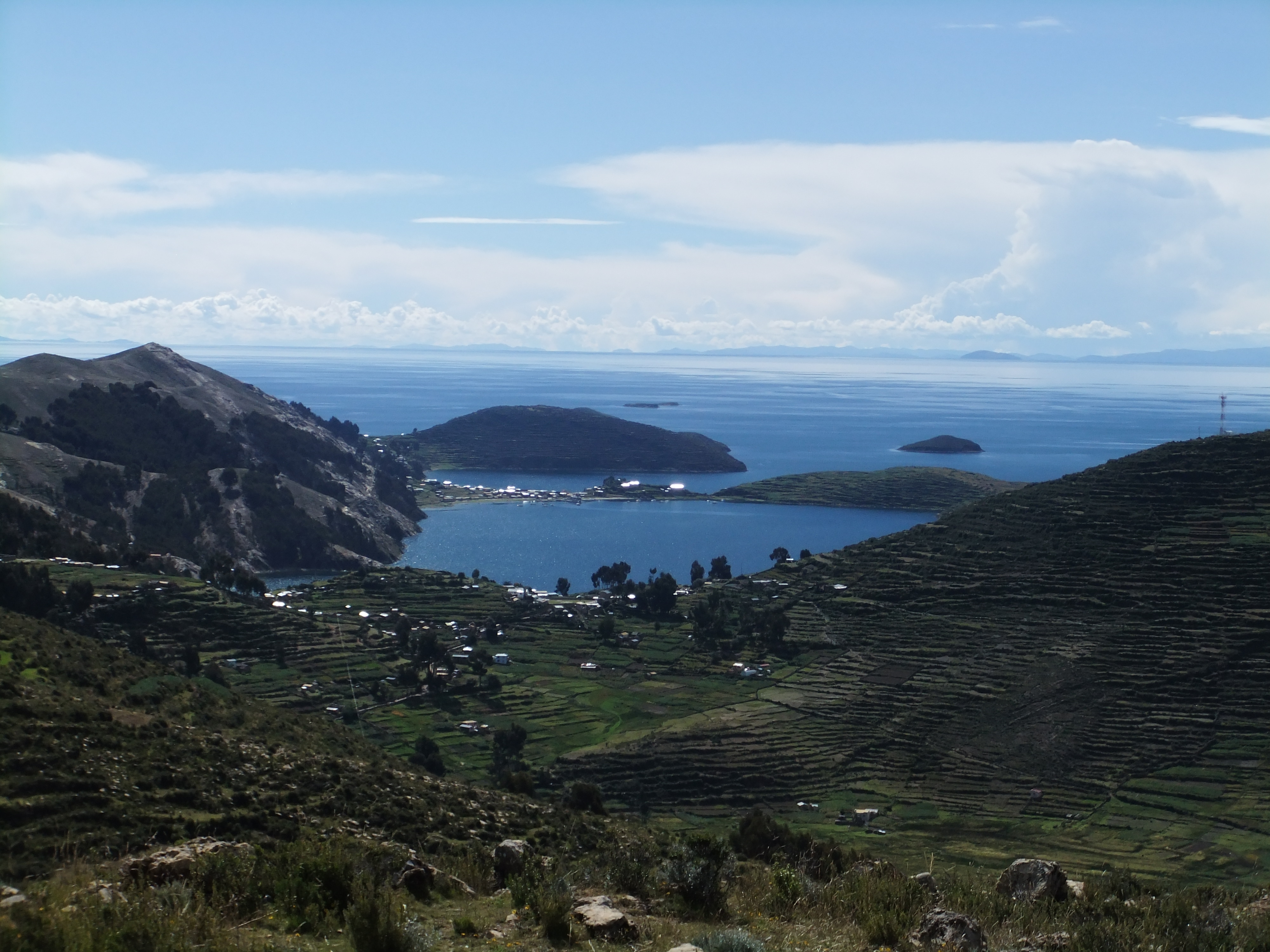
Although I slept most of the boat ride over, I did catch enough to tell you the lake is breathtaking! Lake Titicaca is the largest high-altitude lake in the world. It sits at an elevation of 3808m and is an impressive 8400 sq km. The Cordillera Real mountain range sits as a beautiful backdrop to the lake, with peaks that look too low to be covered in snow (although at that altitude they were anything but low!). 
The Isla Del Sol is, according to Incan Mythology, the place where the Sun was born and where Gods came down to Earth and appeared to mortals – and I can see why: the place is magical.

Yes… this is how I sleep on boats.

We stayed in a village called Yumani, right in the center of the island. When the boat docked it was a thirty-minute hike straight up uneven, rocky stairs with ALL our bags! I felt like I was back on the Inca Trail again, but somehow I’d become a porter! Once at the top, however, the view was worth it. Every hostel and restaurant had a gorgeous view of the lake. We stayed at an East-facing hostel and could see the Isla del Luna (Island of the Moon) from our bedroom window. Not bad for less than $5 a night and a room to ourselves!

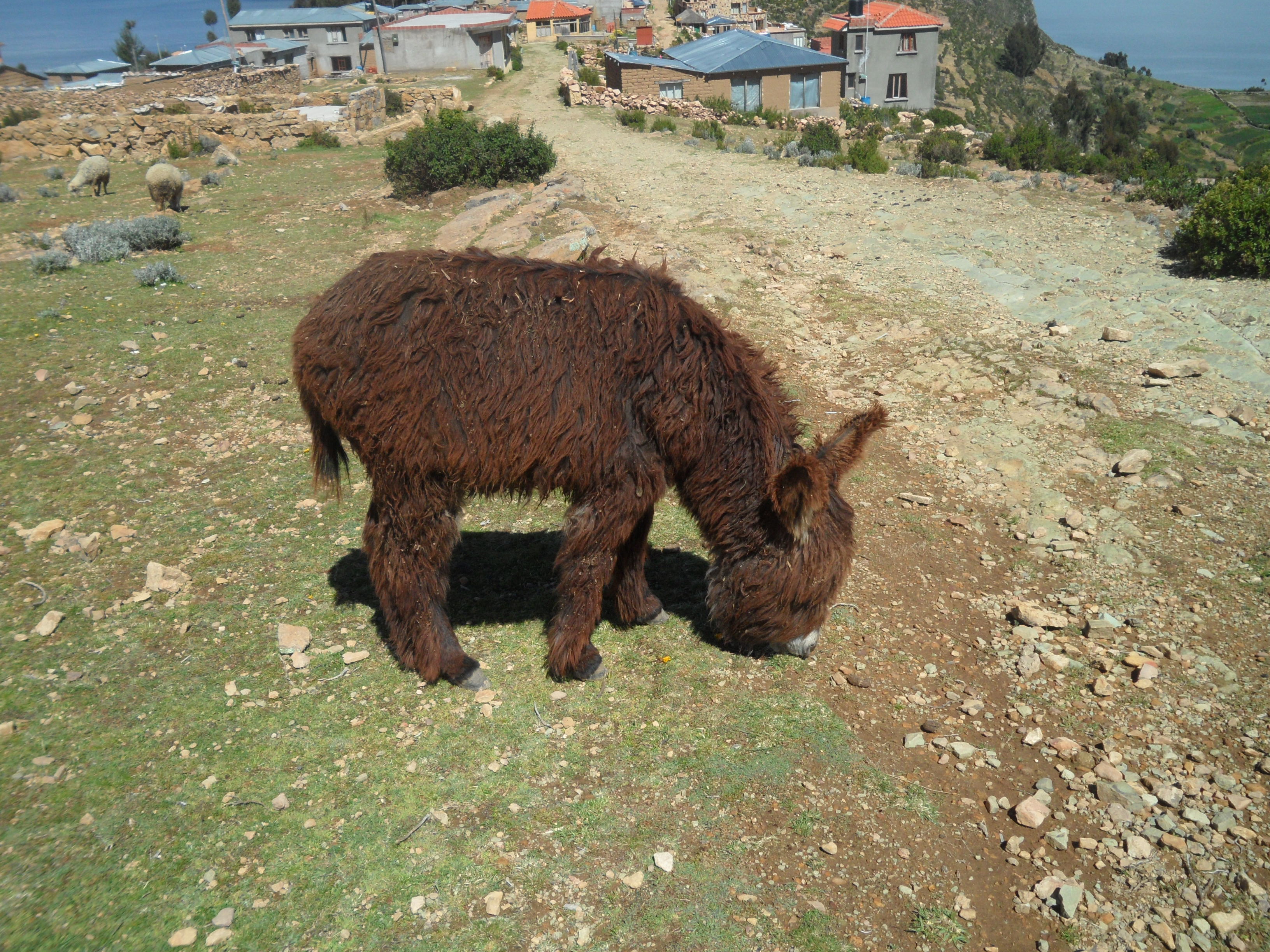
We spent the afternoon walking around the Yumani area. It was very basic, but incredibly beautiful. Apart from the hostels and restaurants, the land was pretty barren. Alpaca’s, pigs and donkey’s roamed the countryside and the locals kept busy working the land or participating in the local soccer match that we could see happening from the top of the hill in the next village over. Once we climbed to the top of the island, it was easy to see how unreal the landscape really was. The water was placid and a perfect deep blue colour. The surrounding islands were green and looked almost uninhabited, and the snow-capped mountain range in the background was stunning. We managed to pick the perfect day for sightseeing, as the sun was shining and there were very few clouds around. You could see forever!

For dinner that evening, we chose a little pizzeria (the Isla Del Sol rivals Rome for it’s per capita Pizzerias) that sat right on a cliff face on the West side of the island. We sat outside, overlooking the lake, and watching the sun go down. At this point in the trip, we were both sick and exhausted. This was the first place I had a headache from the altitude (before only my hands, feet and lips went numb and was more of a confusing sensation than an annoying one) and Adam was progressing into full-fledged cold by this time. We called it a night after dinner, and sat in bed reading, and listening to the incessant braying of donkeys all through the night (they are more persistent than roosters, and a LOT louder). 
We ended up spending only one night on the island, and although we intended to spend some more time in Copacabana, when we arrived, it was so chaotic, and so many more pilgrims had arrived since the previous morning, we decided to just hop on the next bus to La Paz…

Cusco: Relax and Recover

I wish I had more cool facts or fun adventures to include in my Cusco post, because the city really was amazing. Truth is, we spent four days total in Cusco (both before and after the Inca trail hike) simply eating good food, reading, and catching up on my blogs.


Cusco is beautiful. It’s got gorgeous plazas with beautiful red brick churches, fun neighborhoods full of pubs and great food, and the comforts of western civilization like Starbucks (which we spent more time in than I’d like to admit).
  After walking around and getting the feel of the city, we never really left the confines of the main square. Internet cafe’s, great coffee, cozy pubs, lounge restaurants and our absolute favourite: Jacks!

Jacks was an all day breakfast joint that was to die for. By early afternoon there was a lineup out the door and onto the street. Banana milkshakes that literally made me cry one morning they were so delicious, and the infamous Gordo breakfast that is almost too big to finish: bacon, eggs, sausage, tomato, beans, hash browns and 4 large pieces of sourdough bread (the sourdough was probably the most exciting thing about Jacks, considering its tough to find anything other than white bread in all of South America). Needless to say, we went to Jacks 6 times during our stay in Cusco… The staff pretty much knew us by name.


We planned on doing a lot of tours while in the city, and the area really did have a lot to offer. Unfortunately, neither of us could imagine anything topping Machu Picchu, and so we just recovered from our hike. It didn’t make it any easier that we both had colds after our bodies gave up on us the last day of the hike. So it wasn’t tough to make the choice to lounge around.

The day after our hike was over, our group of 16 all got together for Rachel’s birthday at Paddy’s pub: the worlds highest Irish Pub. The place was packed for a Tuesday, and the food and drinks were delicious. With comfort food that only an Irish bar can provide, and two for one happy hour specials, it was great fun catching up with everyone in normal, non-sweaty attire for a change! The pub also fit our description for being part of the main square: heaven forbid we stray too far from our comfort zone.!

Other than that, I think we were both glad our race from Bogota to Machu Picchu was finally over. It’s exhausting sleeping on a bus every second night and waking up never knowing what country you’re in. Luckily, we’ve got some time to finally take it slow through Bolivia… Next stop: Isla del Sol on Lake Titicaca.

Machu Picchu and the Inca Trail

After a couple relaxing days in Cusco it was finally time to start our 4-day Inca Trail hike. We had a terrible sleep after 8 of our roommates decided to party in our room until 1:00am. Our alarm went off a couple hours later at quarter to 5 and I wanted to die… Good start. 
We caught our bus without a hitch, picked up the rest of the group and set out towards kilometer 82: the start of our trek.
  At our breakfast stop in Ollantaytambo is where we first met the rest of our Inca group. There were 16 of us in total; We had a an amazing group of British, Australian, French, Russian and Canadians and even after 4 grueling days of hiking we all got along famously!
  Everyone spent some time after breakfast buying last minute essentials for the trip: walking sticks, snacks, coca leaves and much needed rain ponchos. Then we drove off to the starting point.

Day one was a relatively easy hike. We trekked from Kilometer 82 to our campsite in Wayllabamba along rolling hills for a total of 12km. We stopped frequently for breaks, lunch and to get a brief history about various Inca ruins and the trail itself.
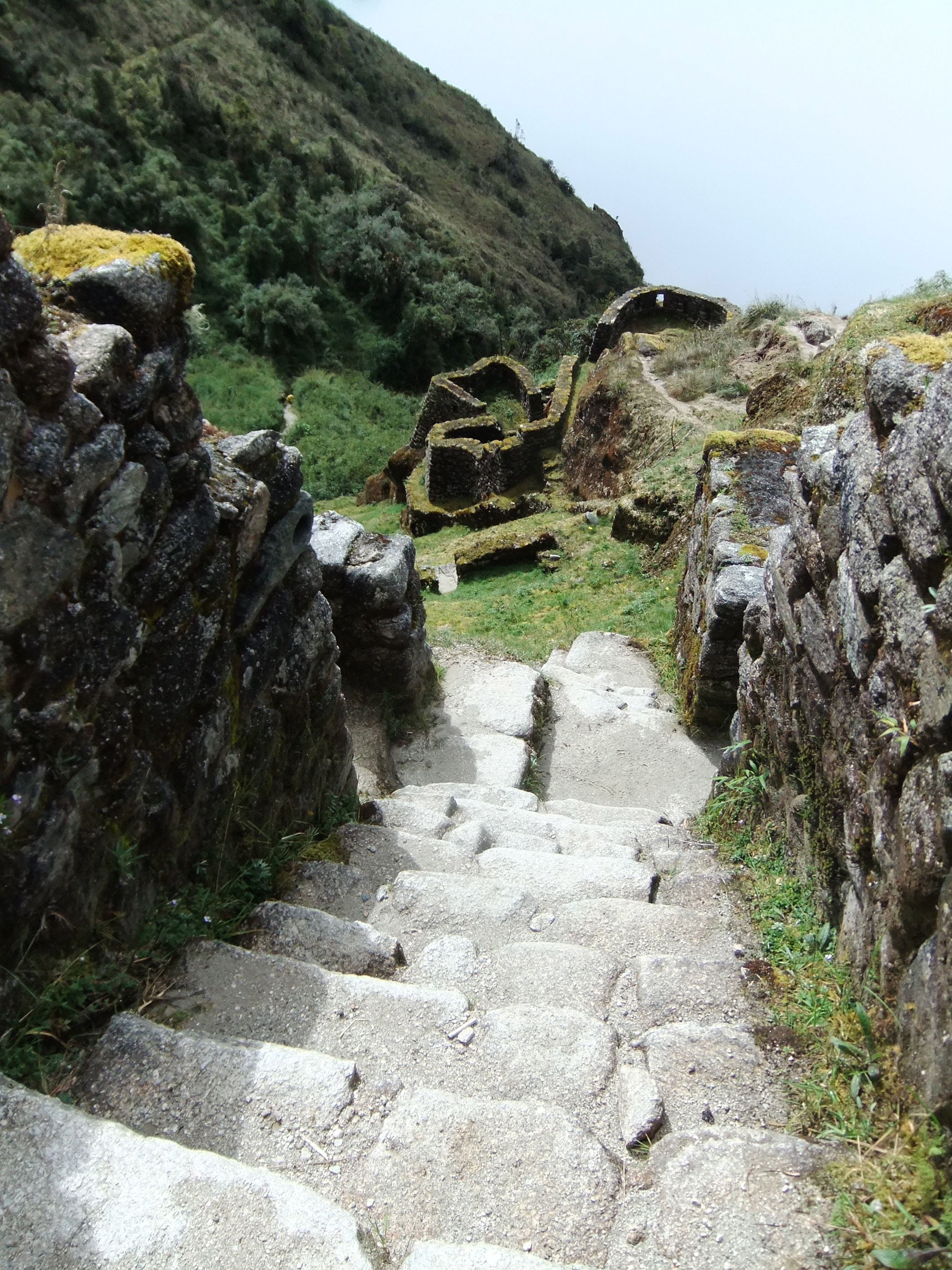
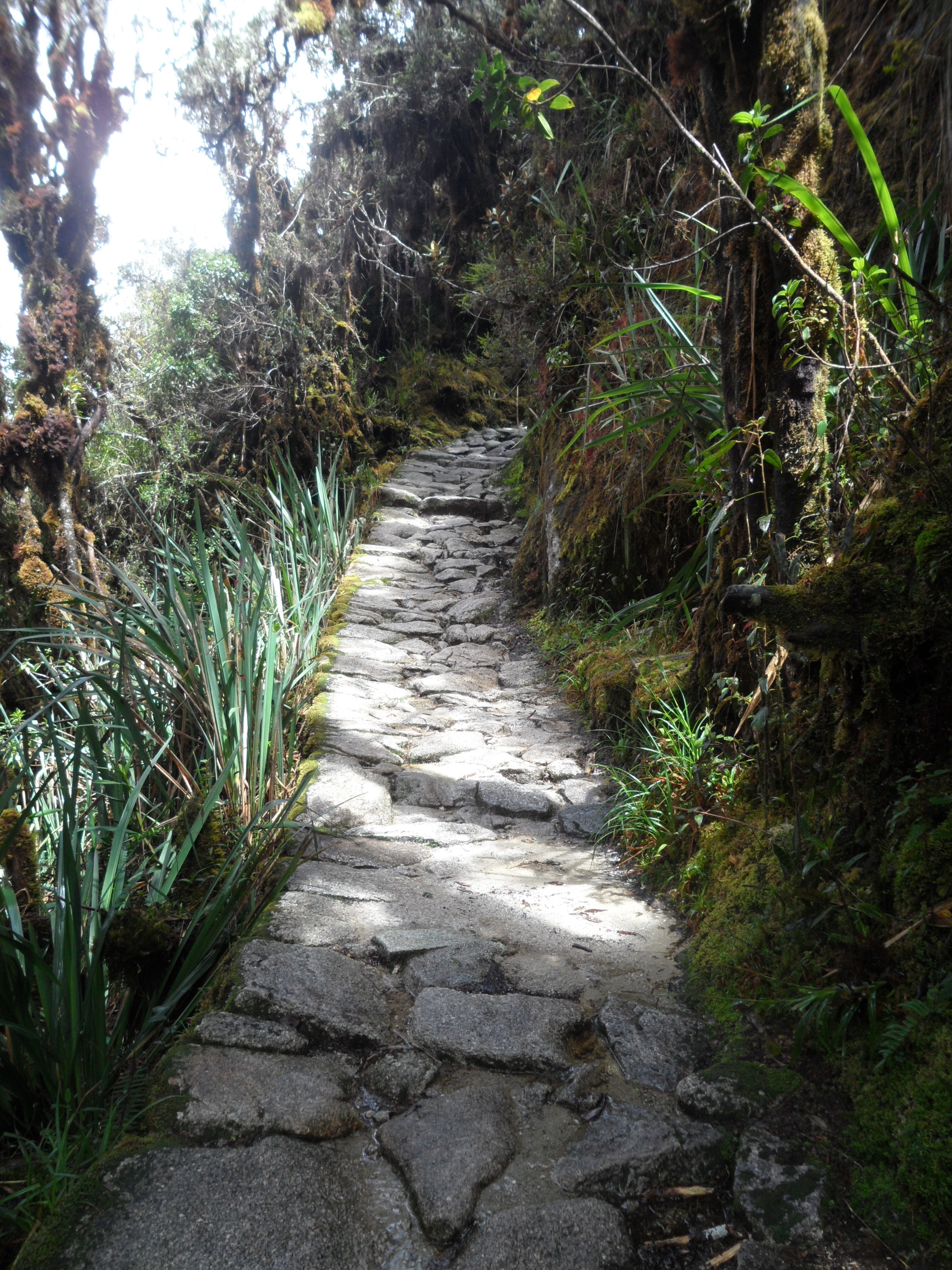
  The Inca trail is actually only 43km long, but, it goes up and down over high mountain passes that reach up to 4200m in altitude; that’s why it takes 4 days to hike. And although we stopped occasionally, I can’t imagine hiking it in less time. 
Turns out, there are actually Inca trail “runs” and “races” that go on during the month of September. Our guide Cesar is actually going to lead one of the runs this year. He and his group will do the ENTIRE trail in 8 hours. When we were told about that, it seemed crazy. After finishing the hike, it seems IMPOSSIBLE! But that’s not even the craziest part: during the Inca trail races they have professional trail runners compete against the local porters for the fastest time. The porters aren’t racers. They are simple farmers that contract themselves out to carry all our things for 4 days in order to support their families back home. The fastest professional runner finished the trail in an unbelievable 5hours! The fastest porter kicked his ass and did it in 3.

The porters are unbelievable! For our group of 16, we had 22 porters and 2 guides. Everyday the porters would race ahead of us, carrying 25kilos of various supplies on their backs: tents, food, garbage, propane, etc. at our lunch checkpoint each day they would greet us with smiles and a warm round of applause for each one of us as we walked into camp. They served us sweet juice right away, then, hot tea. Afterwards lunch was served. This was no ordinary camping; each meal was a three course, 5-star, home cooked meal! We had gourmet appetizers, hot soup, and a full-fledged main course. Sometimes even dessert! On our first evening the chef came in and had banana flambés for each person! We had pizza, fish, fresh salads, beef, and even a baked cake for Rachel’s birthday on the last night. These cooks were really something special. It would be a difficult enough task for two people to cook a hot, 3-course meal for 16 people in a kitchen at home. These two chefs did it while camping! Props to them!

When lunch was over, our group continued on the hike. The porters stayed behind, washed dishes, took down tents, packed up, and raced ahead of us again to have everything prepared for dinner. They were incredible! 
It is now a law that no porter may carry more than 25kilos on his back at a time. Before this rule went into effect, some men would carry 40, 50 or even 60 kilos of supplies at a time. I have no idea how they managed. Even at 25kilos I would have collapsed on the steeper hills. One porter from the GAP tour group was 69 years old and still pulling his weight. He’d been doing the job, 4 times a month for the past 7 years. I have nothing but wonderful things to say about these men who risk their bodies everyday in dedication to their work.

As I said, day one was very enjoyable. We strolled into lunch as a group, were greeted by a round of applause, and sat down to a delicious meal. Adam got jumped by a chicken that was roaming around under the table looking for scraps and I nearly spat out my tea I was laughing so hard. It came straight up between his legs, jumped towards his face, and stole the garlic bread right out of his hands. This was going to be an awesome day…

The scenery on the way was breathtaking! It sprinkled here and there during the day, but it was nice to keep the temperature down and to not get a sunburn on the first day. We had beautiful views of the Urubamba mountain range, stopped at a few Incan sites and learned a lot about the history of the Incas. A British Archaeologist named Haram Bingham discovered the whole area, including Machu Picchu itself. Although many more improvements have been made since his discovery in 1911, he is the reason so many people hike the Inca trail today. Bingham discovered numerous settlements along the way, all of which gave great insight into the lives of the Incans. The Inca people were a warrior race. They conquered tribes and set up fortresses in order to become the strongest empire around. They captured nations according to their skills. The Nazcan people were used for their knowledge of astronomy; the people that lived deep in the Amazon jungle were used for their medicinal purposes, etc etc. Before long, the Incans were masters at nearly every art. And then the Spanish came.

The Spanish introduced westernized culture and religion into the Incan empire. Those who were against the change were tortured or killed. They also brought influenza and diseases that were foreign to the Incan people. This caused thousands of Incan warriors to die. Each village that was discovered by the Spanish people was changed through cultural transformation and widespread disease… But Machu Picchu was never found. The city was built in the hills, often shrouded in mist and clouds, and a number of false Inca trails were created to lead the Spanish armies astray. On top of that, Machu Picchu was not a common city. It was a sacred sanctuary for the ruling family and special priests. Common Incans did not know the location of the city, and so, they were unable to give hints to the Spanish armies. 
The men that traveled the Inca Trail to Machu Picchu were messengers and amazing trail runners. These men ran on foot for days at end to pass messages from village to village. They ran up steep hills and along mountain summits at insane speeds, and always beat the Spanish army that traveled by horseback. Where the Spanish took 7 days in their journey from Ecuador to Cusco on horseback, the Incan runners would make it in 5: entirely by foot. (Just as some perspective… This is how many days it took our BUS to do the same trip with the protests).

Needless to say, it still took us 4 days to hike the 43kilometers along the trail…
After a nights sleep, camping out in tents in Wayllabamba, we were woken bright and early at 6am. Aldo, our guide-in-training, woke each of us up, with a couple of porters offering hot tea and coffee. What an amazing way to wake up. My standards of camping have just jumped up significantly. We packed our things and sat down to a big breakfast of fresh fruit and yogurt, a quinoa and cinnamon porridge and a pancake with dulce de leche. Then of course, more hot tea. We needed to stuff ourselves in order to prepare for day 2 of hiking.

Day two is infamous for being the most difficult day of the hike. The first 5 hours is completely uphill. Giant steps, massive hills and climbing to our highest peak of 4200m altitude. 
To get our energy up, Cesar taught us how to properly chew coca leaves. The coca leaves helped with a number of ailments: altitude sickness, fatigue, breathing difficulties, and if chewed and rubbed on the body, also with joint pain. What a miracle plant! We chewed up a few leaves with a small amount of charcoal for a couple of minutes until our mouths went tingly and numb. Then, after spitting out the dark green mess, we rolled a tiny piece of charcoal on a ball of leaves and left it in our bottom lip for a couple hours of hiking. The stuff really worked!! For the whole hike my breathing never became rapid or hoarse. Even on the steepest inclines I breathed slowly and steadily and found myself much more energized than usual. 
After our coca demonstration we started the hike. Uphill we went, in the cold morning, and in the drizzling weather.

The rain was not ideal, but it could have been a lot worse. The trail was partially in the trees so the rain wasn’t a huge problem. The hike was tough, I can’t deny that, but compared to what I was expecting it really wasn’t that bad. We picked a pace, stuck with it, and never looked up and how much further we had to go. I honestly though I was going to have a rough day, but I made it up to the 4200m summit in amazing time, just behind Adam and Rodrigue, about 45 minutes faster than our guide had anticipated! I was pretty proud of myself. I suppose I had expected much worse, but after hiking the Grouse Grind at home, this was not much more difficult.

When we arrived at the top, there was zero view. Rain clouds covered the valley and the fog made it impossible to see much farther than 100m or so. But we waited and cheered on the rest of the group as they each made it to the height of the pass! When everyone arrived we were lucky enough to have a break in the rain, and got a group family photo of us all at the top! 
From there it was all downhill…

Apparently I’m not as big a fan of downhill as I am uphill. Who knew! Good thing the rest of the 3-day hike was almost entirely downhill. The stairs were steep and uneven, and it was a lot of pressure on the knees. After an hour of descent, my toes began to get blisters from ramming into the fronts of my shoes. The only thing that was easier was breathing. Most of the time you had to walk sideways down the steps because they weren’t wide enough otherwise. After a while, even slight downward slopes were uncomfortable on my joints. But it was only 2 hours to the camp, and we arrived at our final campsite by lunchtime, which was very nice. It gave us a good afternoon to relax our tired bodies for the next day of hiking. When we arrived, I immediately stretched my legs, assuming they would be a little sore the next day. When everyone else arrived, we ate another wonderful lunch, had some down time, an early dinner and then a VERY early bedtime.

When the sun went down, the camp sight was FREEZING! I wore every layer I had and was still shivering. Luckily our sleeping bags were wonderful and so we all just called it a night early and went to sleep.
  Night two’s sleep was uncomfortable. The sleeping mat might as well have been the hard ground, and every angle I tried left me in agonizing pain. I tossed and turned, not wanting to leave the sleeping bag to sit up for fear of the cold. By the time Aldo woke us up at 5:30am to start the morning I was exhausted. Not even Coca tea helped. But the worst part was my legs wouldn’t move. My quads were complete jelly from the day before. Stretching obviously didn’t help. I had to use Adam as a crutch just to stand up, and even then it took about 5 minutes for my legs to warm up enough to stop my shaking muscles. Uphill was fine! I had no problem walking UP the hill to breakfast, but walking DOWN the hill to the bathroom was a different story.  
For those people who say day 2 is the hardest, they are wrong. Day 3 was my nemesis…

We started hiking by 6:20 and went uphill. We had another peak to climb to before everything else was downhill again. I limped along for a few minutes before warming up enough to not be in pain. Then it rained. We hiked up steep stairs in an icy rain that came at you from all angles. No matter which way you turned it was blowing in your face. The wind spun around in circles, chilling me to the bone, even with all my layers on. One of our activities of the day was to make an offering to Mother Earth at the top of the second pass. We each carried a rock up the mountain, and then, waited for everyone to arrive to make the ceremony. This was the low point of my trip… 
I couldn’t feel my hands from the wind and rain. Sweat and water ran down my face, into my eyes, and no part of my body was dry enough to wipe it off. My running shoes were soaked, and every step I took I could feel my waterlogged socks slosh around. I stood shivering at the top of the pass for 15 minutes waiting for the last of us to arrive. With so many groups all moving at once, the line was slow, and it took longer for everyone to reach the summit. When the time arrived, we all just put our rocks in a big pile and that was it. Not impressed. If we had just kept walking we would have been A. Warmer and B. 20 minutes closer to our final destination.

Today’s hike consisted of 11 hours of hiking, I did NOT want to waste time standing in the rain. I put on the alpaca gloves I bought in Arequipa, but every 10 minutes or so I had to wring them out they collected so much water. Then we went downhill. Each step was agonizing. I couldn’t go fast, because the steps were so uneven, but if I went slowly, I thought my legs would buckle under. I walked for 40 minutes without seeing another soul (apart from the passing porters). I was only a couple people from the front of the group, but everyone went at their own pace, so we rarely caught up to each other. The rain was not helping. If the sun had been shining, it may have been pleasant, but there was no view, no warmth, no end in sight. Just fog, and stairs and aching muscles… Why did I do this trek? 
We stopped at another Incan ruin but I hardly listened to the explanation because I was trying to keep warm, and not let my quads cool down. Every time we stopped, my muscles cooled and I had to start all over again. As we walked downhill on uneven rocks I began to curse whoever designed this stupid trail. Why did it have to be so uneven?!

Finally the rain slowed and the sun revealed itself by early afternoon, only 6 hours or so of treacherous hiking in the rain. We had a bathroom break, I ate a pack of M&Ms to get my sugar levels back up and I instantly felt better. I was still soaked to the bone, but at least the sun was warm and there were some amazing views to be seen. A few of us walked together until lunchtime. We stopped frequently to take photos (as this was our first good view in three days) and took it slow to lunch. The sun dried almost all my layers, except for my shoes and socks: they were a lost cause. 
Lunch was amazing as usual, an after a short break of relaxing we continued in our way.

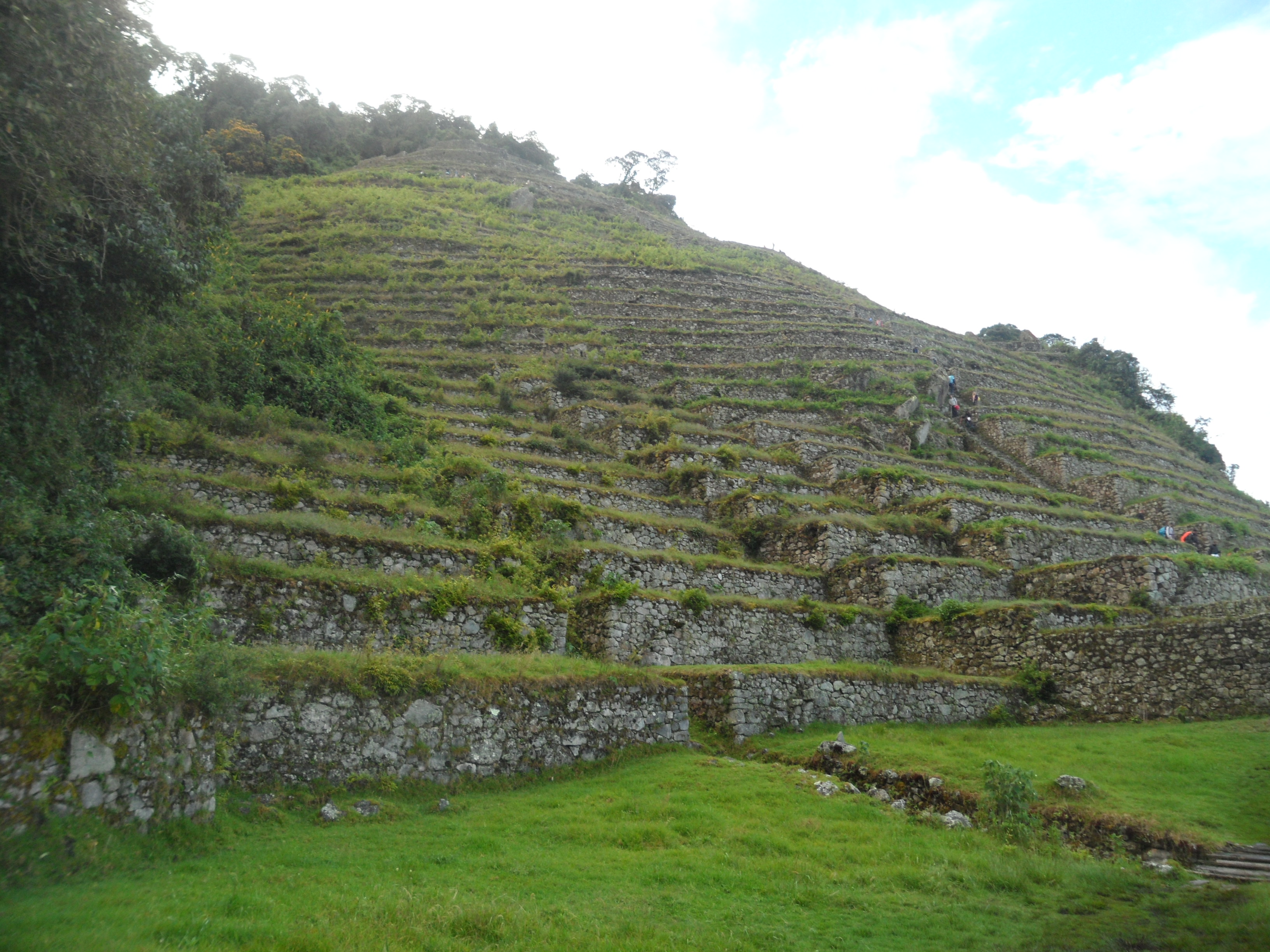
The next part of the trip was called “the gringo killer”. Great. It was named so, because of its steep, never ending, downward stairs. Double great. It was painful to say the least, but at least I wasn’t freezing. We managed to stay more together as a group, so morale levels were slightly higher than our morning segment. As the day grew closer to an end, we had the option of taking the shortcut route to camp, or the 25minute longer scenic route to “the terraces”. Even with all our aches and pains everyone chose the terraces. They were beautifully crafted stone and grass terraces that jutted out along the mountain pass. It was a breathtaking view. We took loads of photos as the sun slowly sunk behind the mountains. Then we made our final leg of the day and hiked the 20 minutes back to camp.

15km of hills and 11 hours on the road we finally arrived at camp: the last of our long days behind us. Total number of stairs to date: over 4000! Fortunately, from here, we only had a short 5km to make it to Machu Picchu, and the walk was only rolling hills, much like day 1. What a feat!
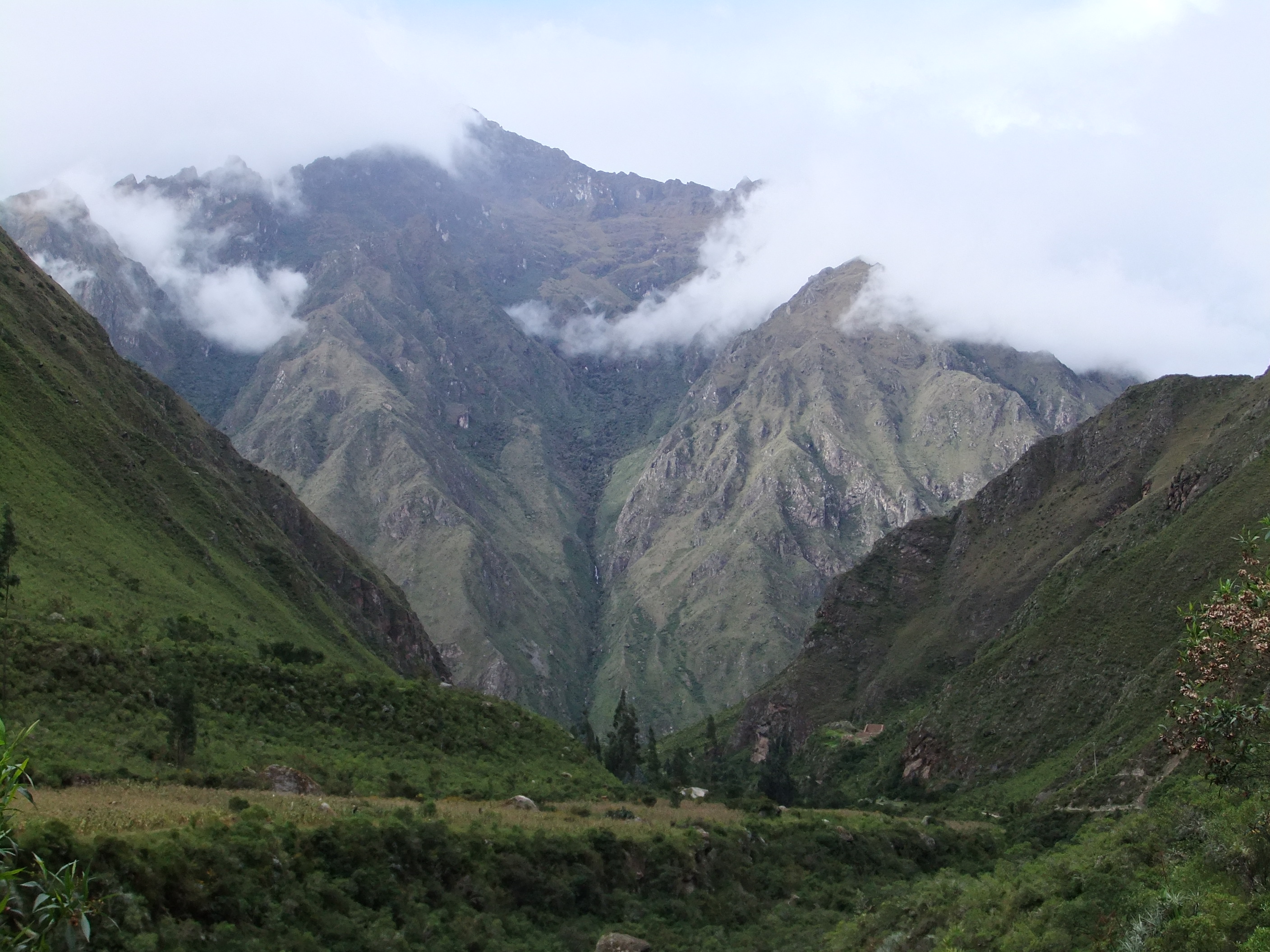
  The last morning our wake up call was at 3:50am. This time there was no room service of hot tea and coffee, just a dark, cold morning and another struggle to get out of bed with sore muscles. We forced down a tiny breakfast and started walking by 4:40. It was still dark, and I was definitely still disoriented about whether I was awake or asleep. As the sun started to come up, all we could see was that we were completely surrounded in clouds. We walked along cliff edges, but looked out into a blank white sheet of air. Who knows how deep the valley went, or what the view was like. Occasionally the top of a mountain would peek out from behind the fog, and then disappear just as quickly. We passed two different landslides on the two-hour walk, one that had happened only a week earlier, the other, two weeks earlier. A makeshift path was created, but our guide warned us not to linger to long on it.

After 2 hours of walking we made it to the Sun Gate. This is where you are supposed to see the first glimpse of Machu Picchu… All we saw was white and rain. We hung around for a while, hoping that the fog would lift, but to no avail. So we continued hiking downwards towards the ruins. It took only another 20 minutes or so before we reached the stereotypical “postcard” view of the ruins. 
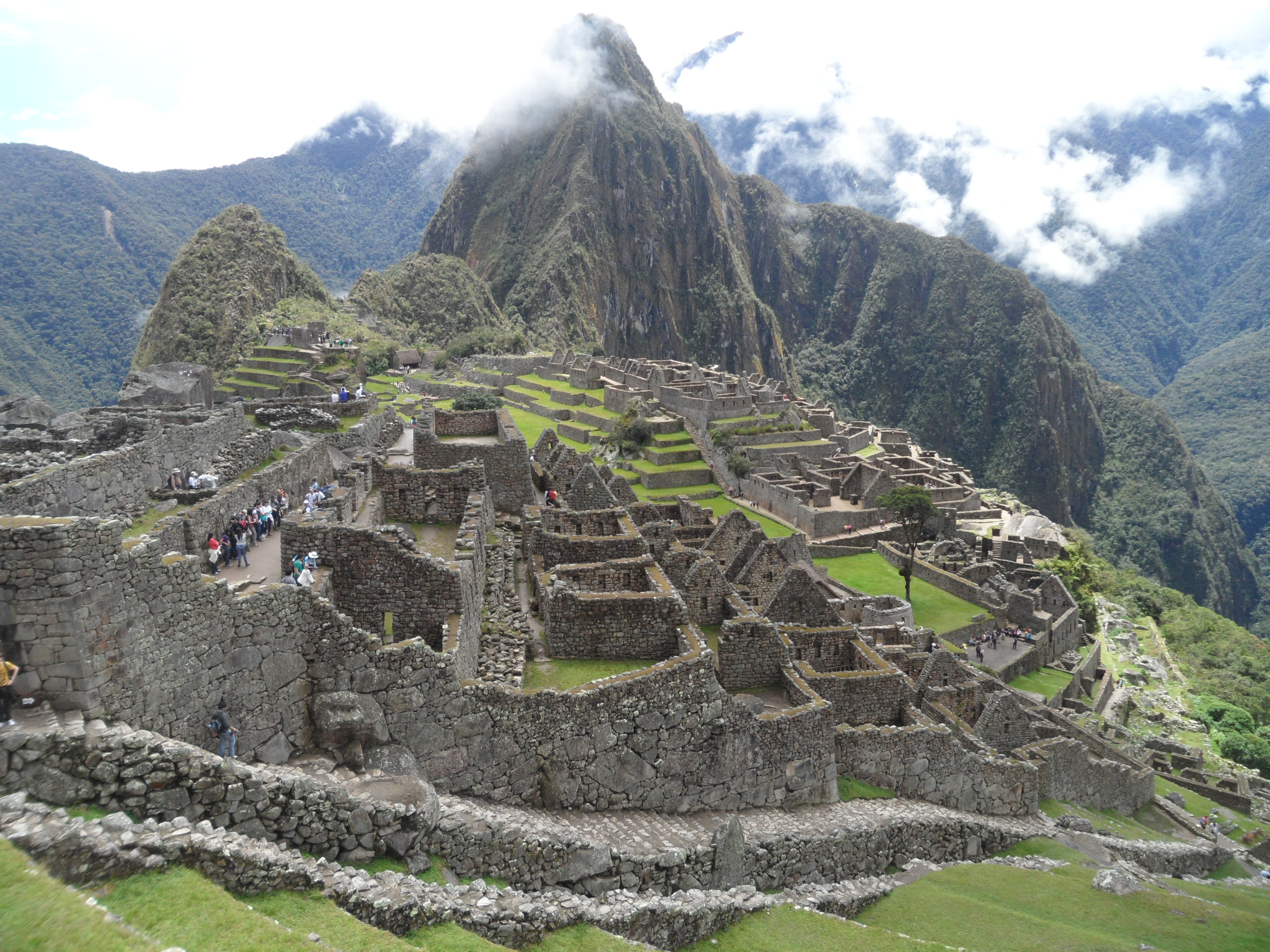
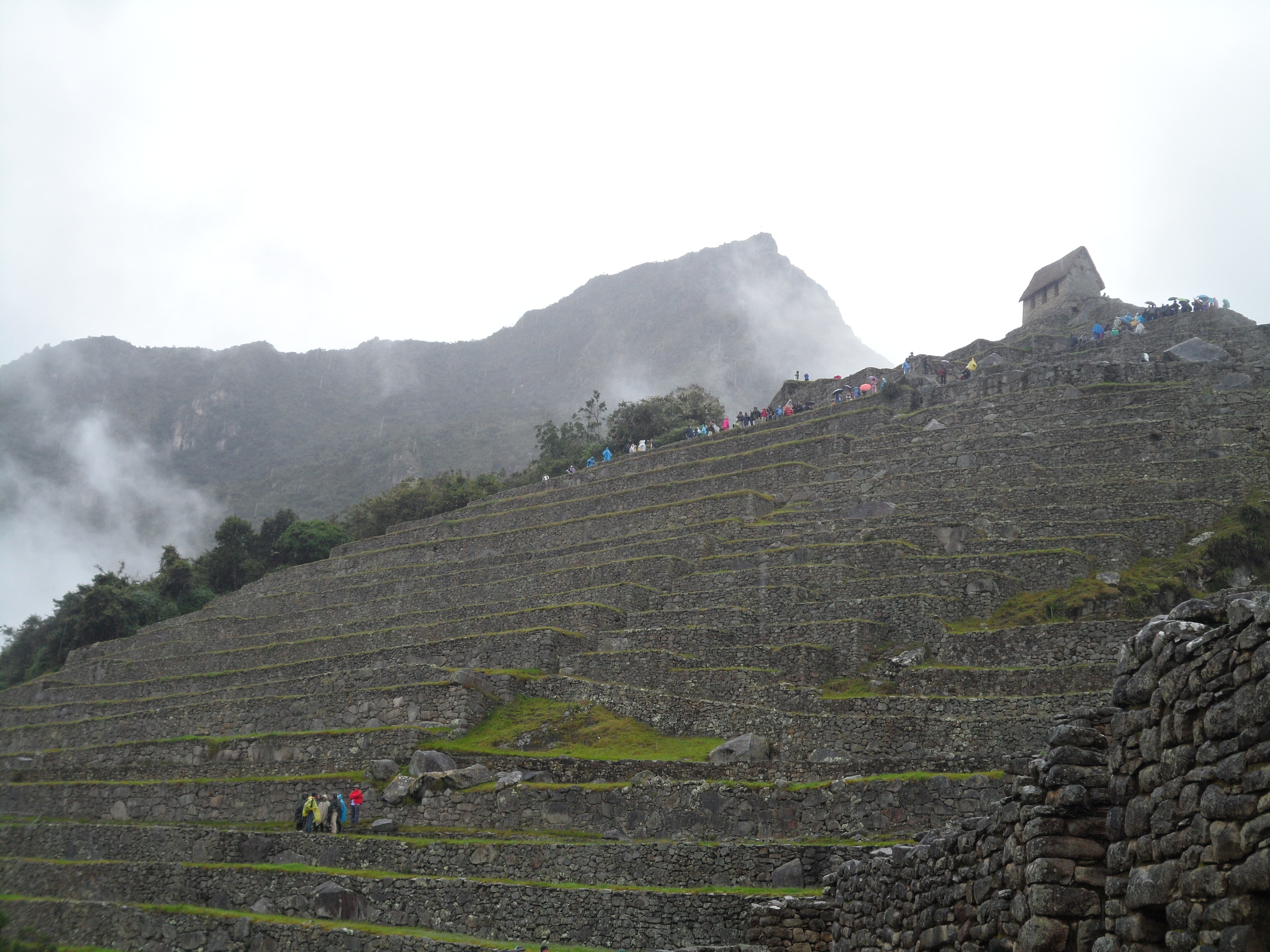
We had finally made it below most of the clouds and could make out the city fairly well from where we stood. The place was massive! An entire city, at one point housing over 1000 people, almost fully intact! Unfortunately, the clouds mostly covered Huayna Picchu, the mountain that sits behind Machu Picchu, but we snapped some shots anyways before continuing down to the main tourist gates.

It was definitely surreal being surrounded by hundreds of clean, fresh looking people. After 4 days of hiking in the rain, wearing the same outfit, being excluded from civilization, not showering, and limping with exhaustion, it was very weird seeing clean, well-dressed people, chatting on their cell phones, in dry, uncrumpled rain ponchos just hanging out for the day. Just a short couple hours on the train, or a vigorous 4 day trek through the wilderness: almost seems unfair that there is another option. Even with my jelly quads, I’m glad we hiked it. It makes the whole place so much more magical and amazing!

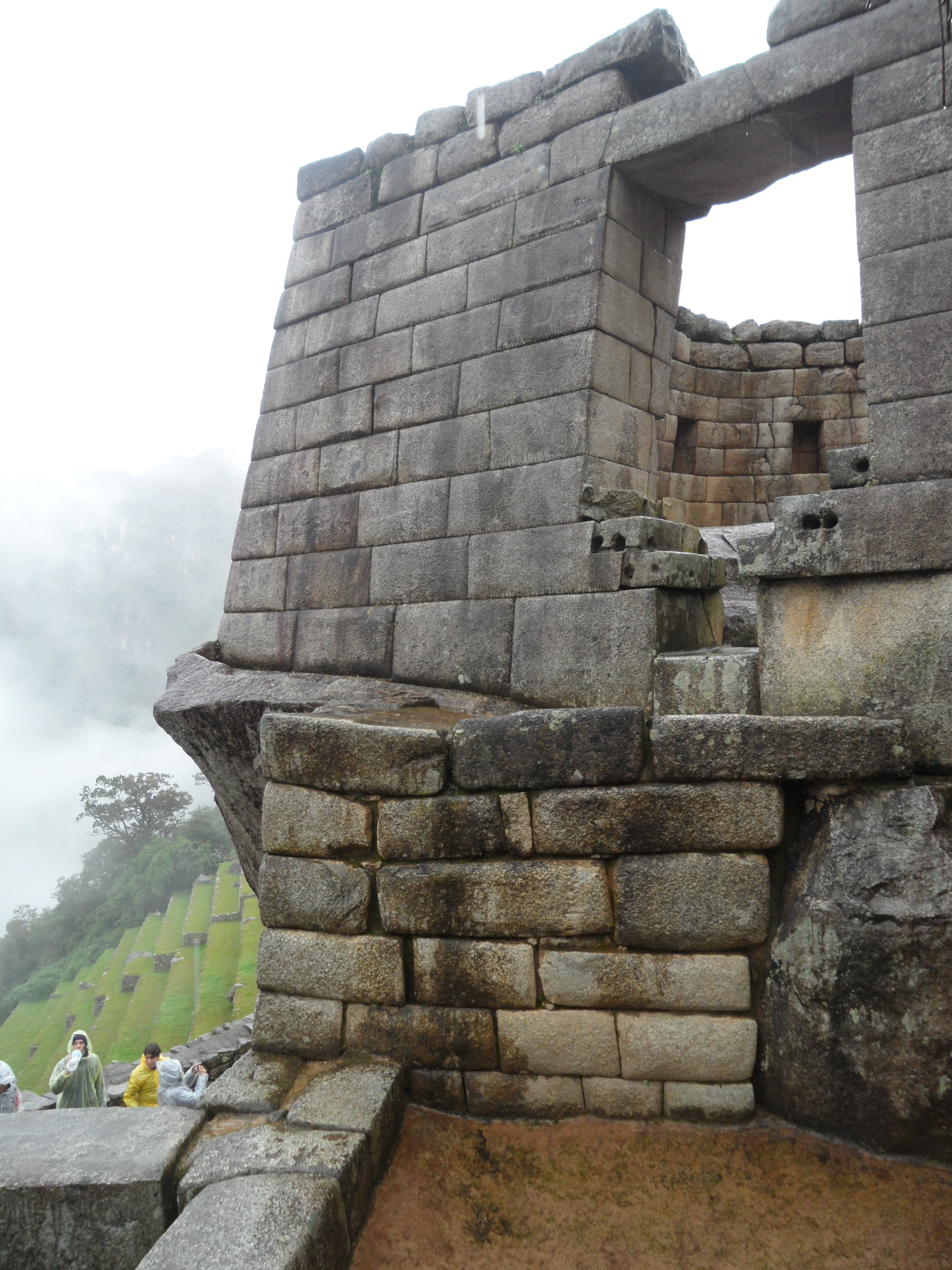
After a quick bite to eat, Cesar took us on a 2-hour tour of the ruins. We saw the priests’ temples and the royal family’s living quarters; we learned how knowledgeable the Inca people were with astronomy and construction. All of the Inca structures were built to be earthquake proof. By building the walls and doors at a slight angle, and keeping some of the natural landscape to fortify the walls, these structures could withhold almost anything.

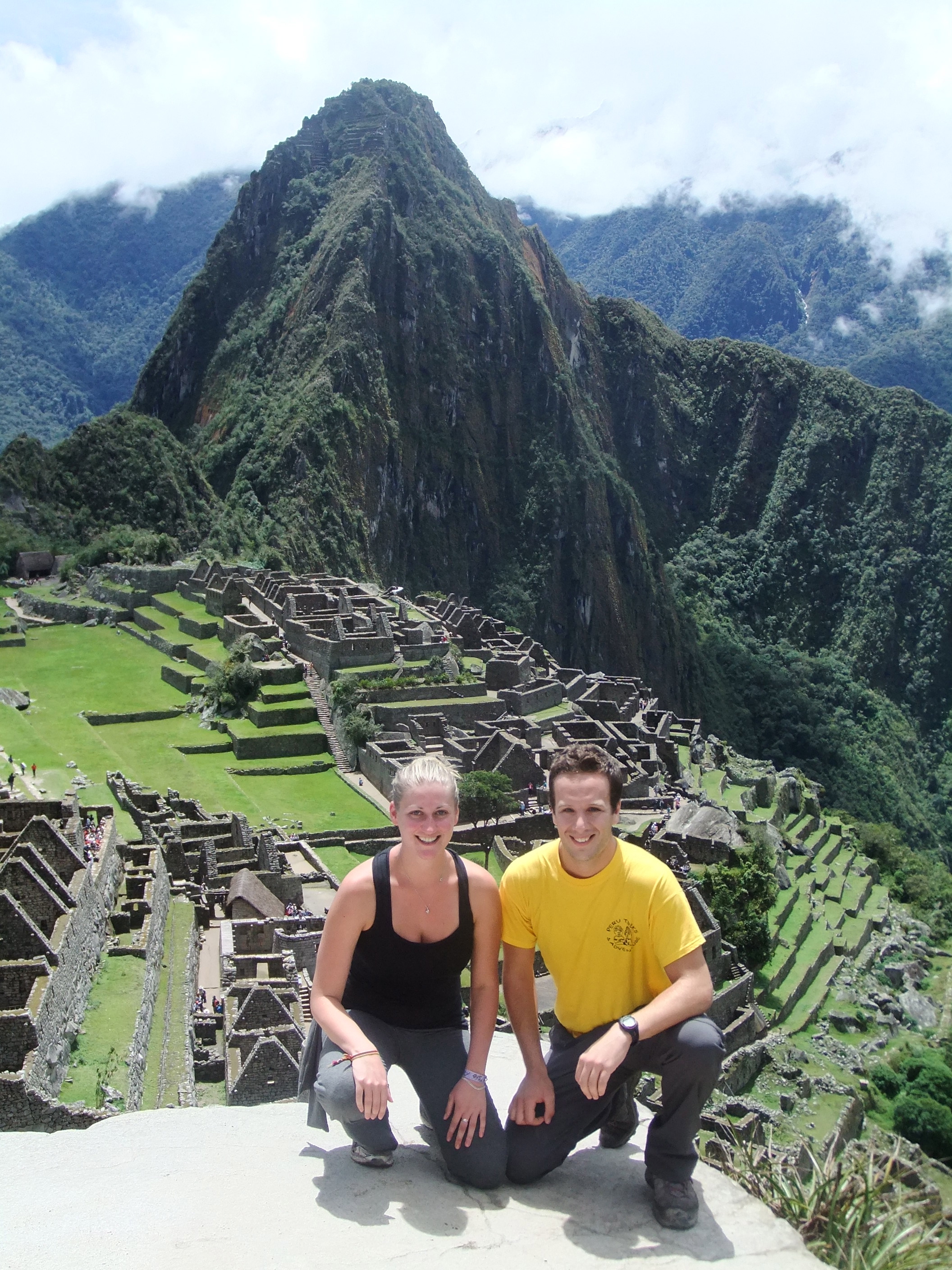
When we finished the tour, the rain and clouds lifted, the sky turned blue and the sun shone down, warm and welcoming. We had a couple hours to explore the ruins on our own, and this is where I finally realized how gorgeous the place really was.  
I said before that Rio was a dramatic city, but the landscape surrounding Machu Picchu is absolutely dramatic in every sense of the word. I’ve never seen mountains like this before. Ones that are huge peaked hills, each completely separated from the other in looming towers of green. They are steep and dangerous looking and majestic in the misty clouds of morning.

Machu Picchu itself is built on a steep mountain. The backside of the city drops off into a dangerously vertical cliff, and it is believed that many people were killed during this part of the construction. Gorgeous terraces spread upwards along the side of the city, and at one point were used for crops and gardens. The structures of Machu Picchu now are only stone walls, but when the city was in use, each of the buildings had dried, straw thatched roofs, smeared with llama fat in order to make them water proof. They say that when the sun shone down on the city, it lit up like gold with the beautiful, light tan structures. When you picture this, the entire city is even more surreal than before.

While the sun was shining, we hiked back up to the viewpoint where we first spotted Machu Picchu. It was spectacular now that Huayna Picchu was clearly visible in the background. We snapped some more photos and then finally trekked back in the bus to Agua Calientes (a town about 30 minutes from the ruins).
  We ate lunch, had a few beers in celebration, then spent the afternoon playing pool until our train left at 6:45 that evening. A few of us celebrated our successful hike with a bottle of rum back on the train, and by the time we arrived in Cusco we were dead tired. But all in all, SUCH an amazing experience; as well, another world wonder off the list… Check!

Arequipa: Ceviche and Frozen Mummies

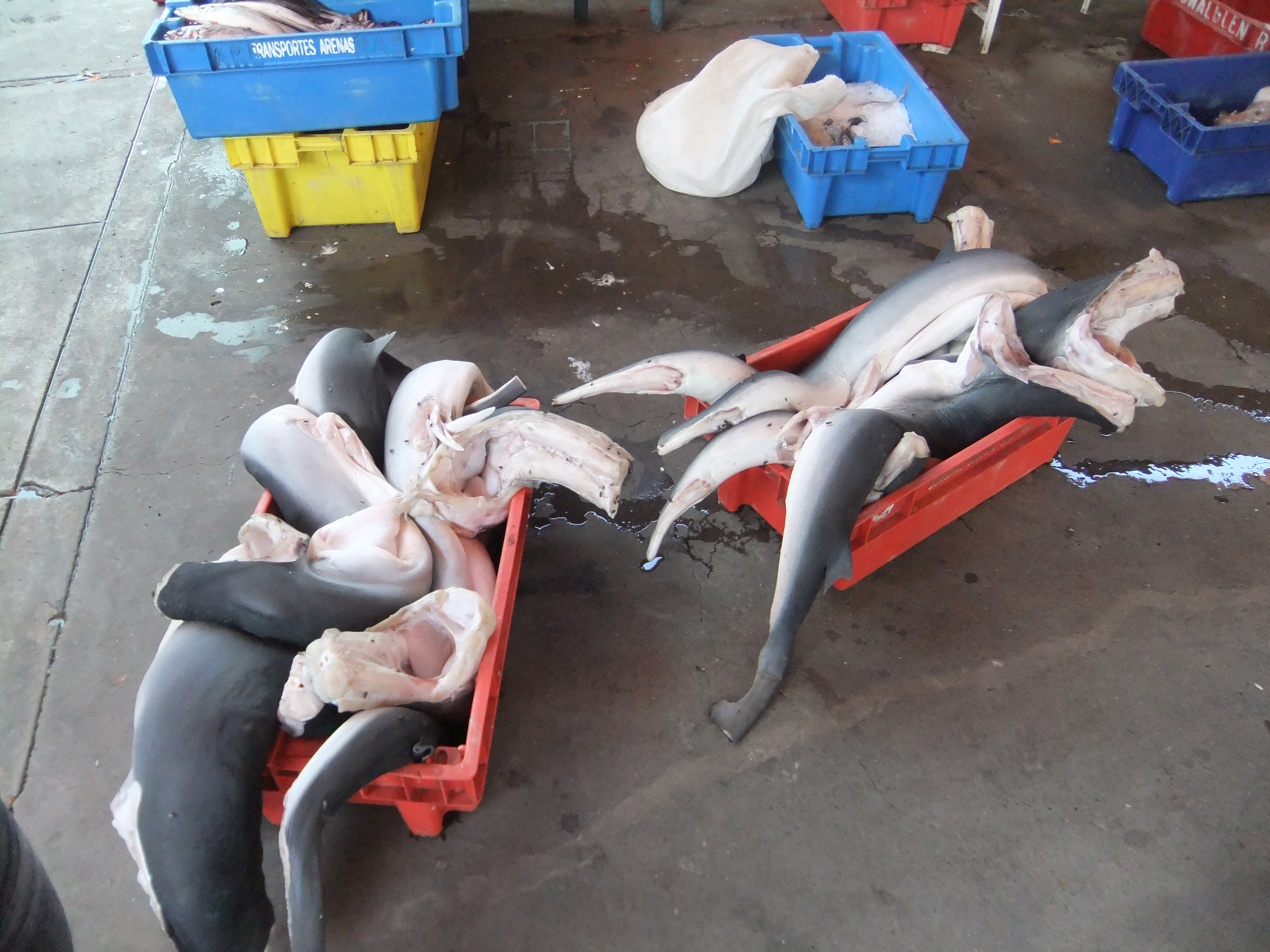
The morning after our Colca Canyon tour we had booked seafood cooking classes through a hostel called Casa de Avila. We were scheduled to make traditional Peruvian ceviche and a fried blue shark dish with a hot salad on top. Sounded amazing!

So we got up early and set off for the hostel. The first part of the class was a market tour. Our guide, Armando (who is also the owner of the hostel, and who only runs the cooking classes occasionally himself for fun), took us in his van to a small local market, where we learned how to properly buy and ask for the necessary foods. The market was really great! So many local meats, fish, vegetables, spices, fruits, cheeses and so forth were all nicely laid out in front of their vender.

We walked from vender to vender repeating the appropriate “buenos dias casera” to each one of the women. We even stopped at a local medicine man that worked in the market every morning of the week. He had a huge array of spices and herbs and fruits that he mixed into special healing drinks according to each person’s ailments. Apparently these medicine men are quite common around Peru, and this particular man’s station usually had a lineup around the corner with people looking to get cured of their cough, headache, arthritis or simply get a new surge of energy for the day. The medicine man mixed us up a warm drink specific to having energy that was DELICIOUS.


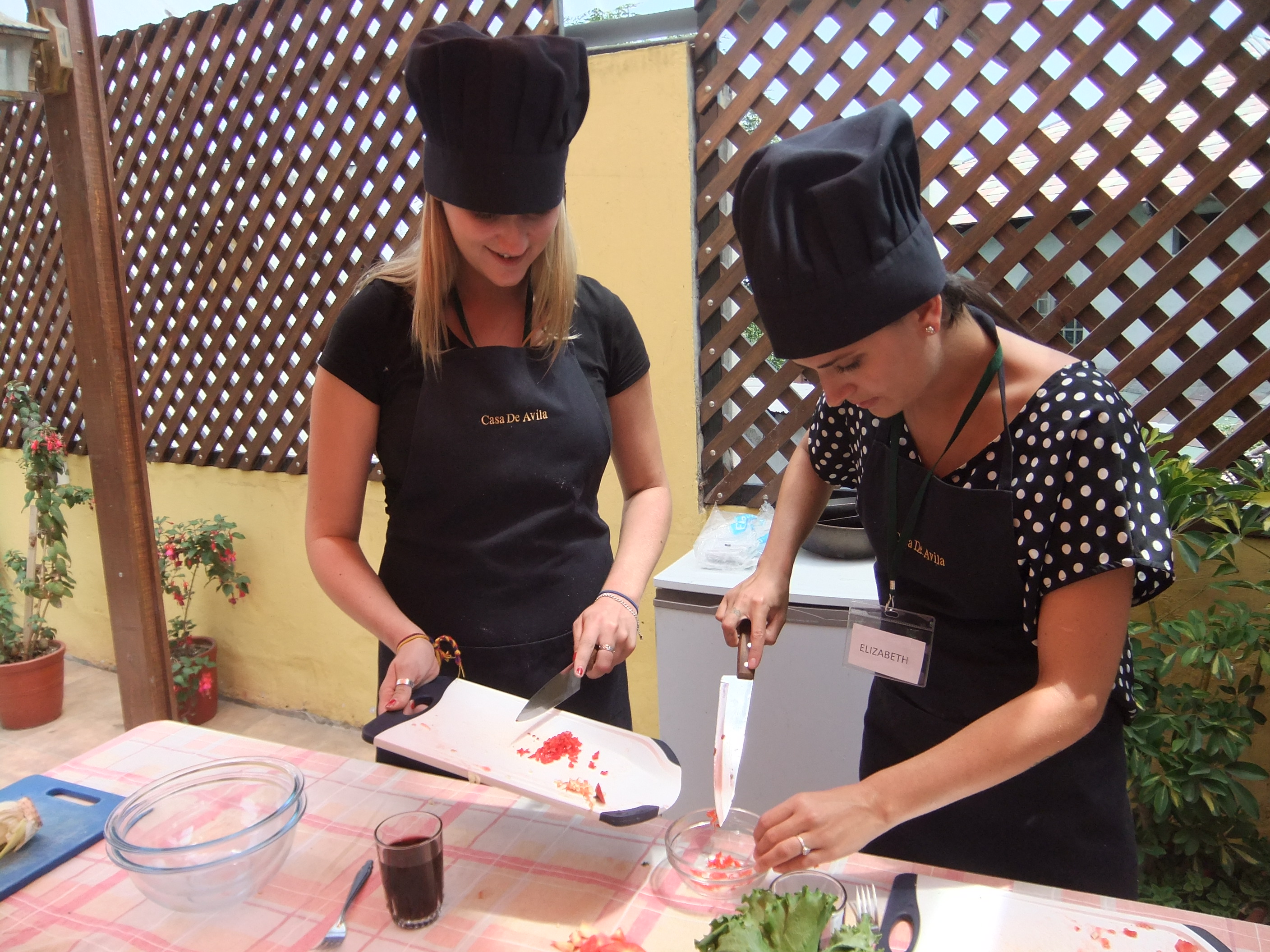
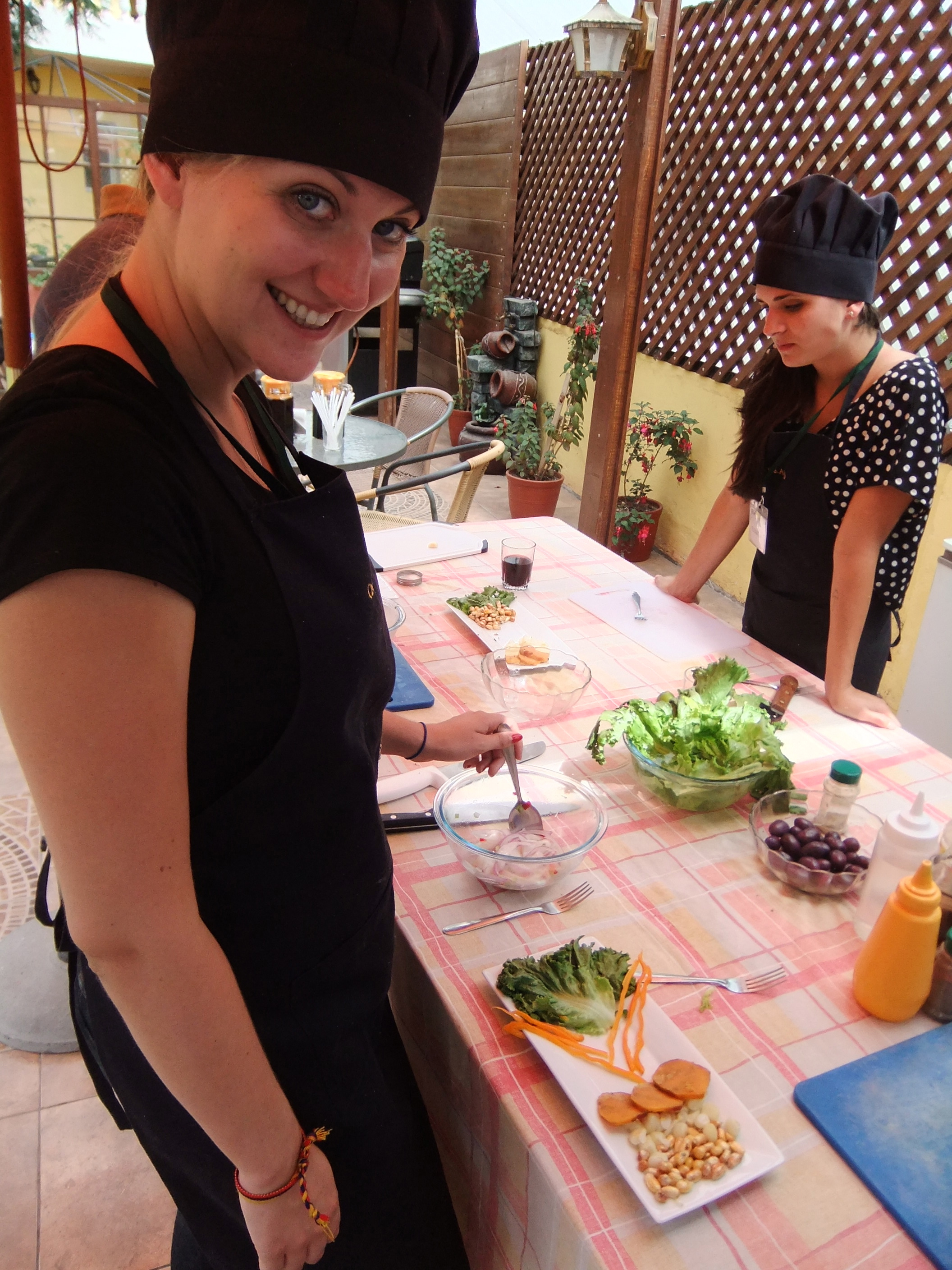
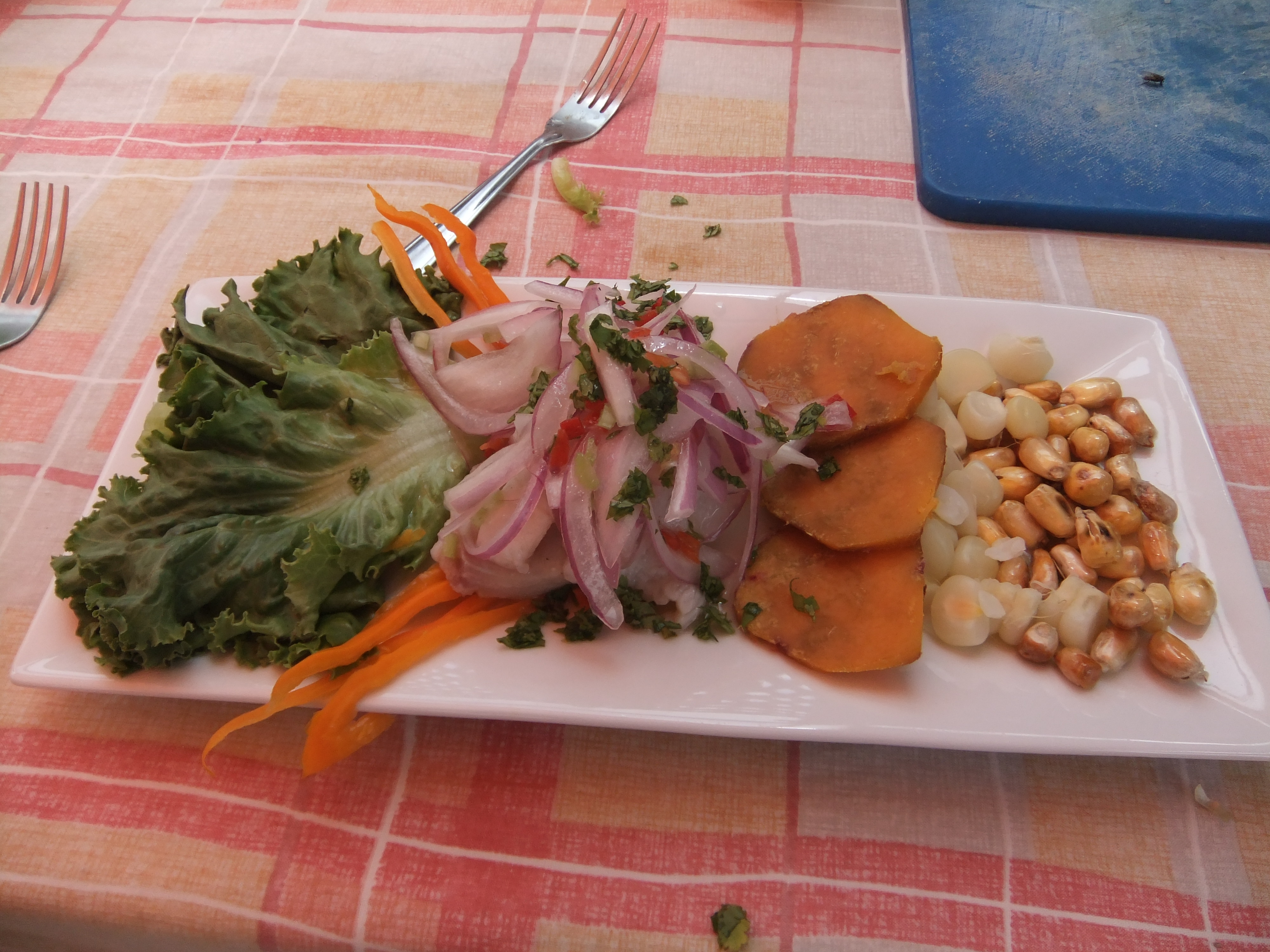
We arrived back at the hostel an hour and a half later to begin the cooking process! There were 9 of us in total, 7 Americans and Adam and I representing Canada! We were adorned with chef hats and aprons and then started chopping! We had so much fun putting everything together for the ceviche, and the end result was outstanding! For those that don’t know, ceviche is a raw fish dish adorned with onions, chili peppers, toasted corn and sweet potatoes. The fish is marinated in lime juice and salt which briefly cooks the fish And gives it an intense citrus flavour! Can’t wait to make the recipe again at home.

We all sat down with our dish to eat and was served a sweet, purple juice made from corn. We all got along, chatting about our trips and giving each other tips on places to go next. Then we started the main course: fried shark.
  Although this dish looked more complicated, with lots of flavors, veggies and fish all served on a bed of rice, it’s actually quite easy. Pretty much all the ingredients go into one large wok. And apart from cooking the rice, the meal was made in a matter of minutes. We only had one minor glitch, when our wok, handle and all, lit on fire, nearly burning off Adam’s right hand. But, after we put out the wok, the handle, and the dishcloth that sadly also perished in the fire, our food was perfectly cooked! Oh, and Adam is just fine.

The cooking class was a definite highlight in Arequipa. And I think we plan on doing one or two more in the last month of our trip if we run across a good one!  
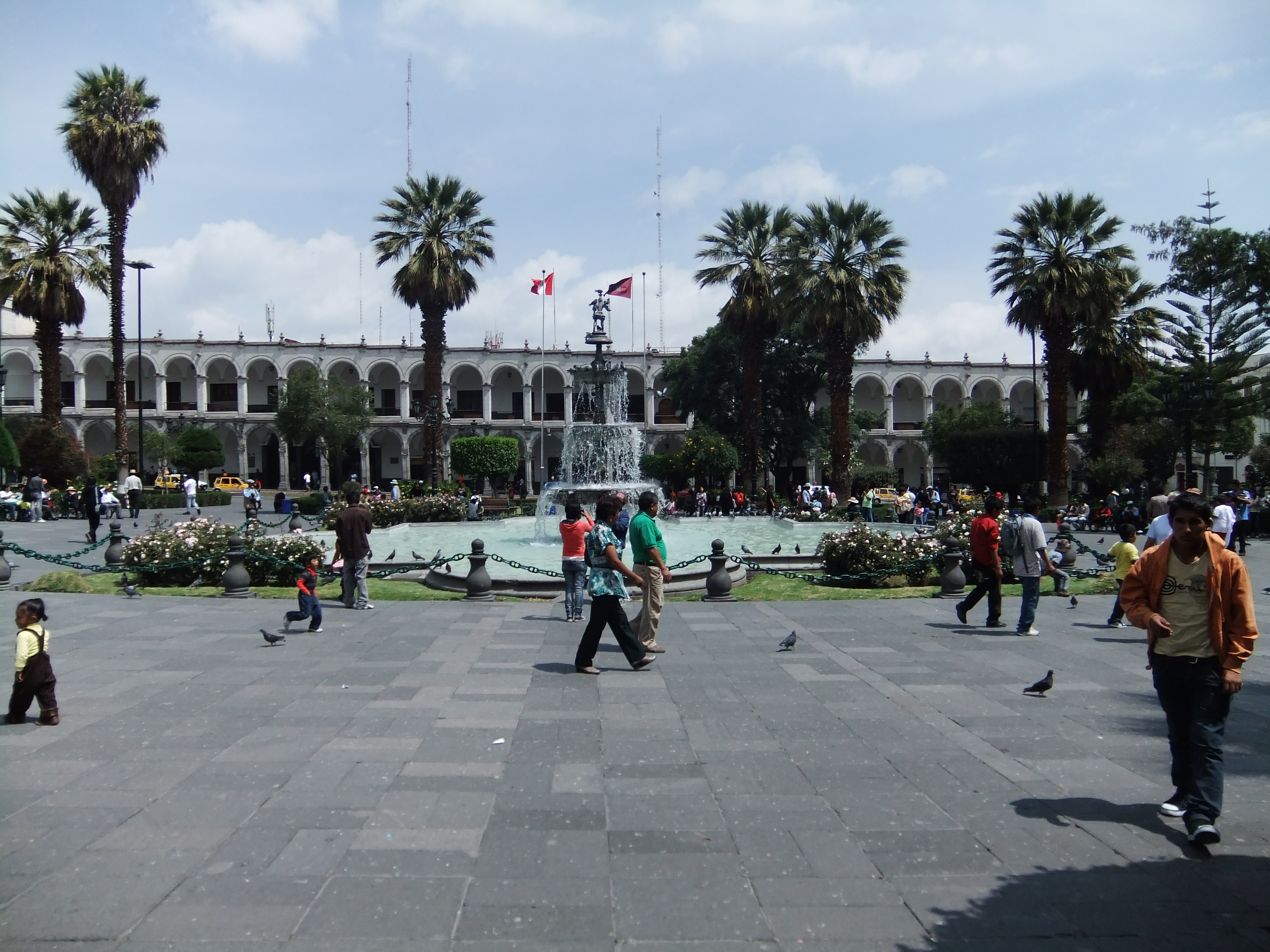
For the rest of the afternoon we just checked out the city sites. Arequipa is a beautiful colonial city with a gorgeous main Plaza de Armas that lights up at night.

We sat in one restaurant that had a balcony overlooking the plaza and had endless fun people watching below. We weren’t quite sure what was going on, but it seemed as though there was a very important wedding happening. There was a bride and groom all dressed up, several bridesmaids, a FULL marching band and several important looking army officers all dressed in their official attire. However, everyone looked dislocated from the other, and no ceremony took place that we saw. Either way, endless things to watch!


On our final day in Arequipa we stopped in at the “museo santuarios andinos” to check out the frozen ice princess “Juanita” that was discovered on top of Ampato Volcano in 1995. The museum was opened, and is still operated by, Dr. John Reinhard, who is the man who actually discovered the frozen bodies. The place is run, mainly, by university students; they are a wealth of knowledge and depend solely on tips for their wages. The museum explains about the bodies of 4 children that were found, almost perfectly preserved by the cold, on top of Ampato Mountain.


In Incan times, the people believed that the gods lived in the nature around them. The tallest mountains, the vast ocean: mother earth was a living creature, and needed to be worshipped. When natural disasters like earthquakes or volcanoes happened, it was a sign to the Inca people that the gods were unhappy, and sacrifices needed to be made in their honour. The Inca people chose pure, unblemished and innocent babies as human sacrifices to the gods. The children grew up knowing that, when the time came, they would be sacrificed for the betterment of their people and live their next lives among the gods.


When the sacrificing time was right, young girls, none older than 13 or 14 years old, would make long treks (days or months) through rugged terrain, to make it to the sacrificial place. Ampato Volcano is the highest mountain in the region, it was, therefore, a popular place for sacrifice.  The Incan priests, and the young maiden climbed up the 6,380meters above sea level to perform the ritual. The girl was given a powerful, hallucinogenic alcohol to sedate her, then, while lying down on a blanket, the Incan priest would smash in her skull with one precise, yet deadly blow. The maiden was then buried, in the foetal position, with all her worldly possessions: pots, dried food, dolls, small statues of animals etc.  These possessions would carry on with her into the next life.


500 years later, in 1995, the maiden’s body was finally discovered. A couple years after that, 3 more bodies were found, in similar circumstances. All of the children were between 12 and 14. 3 were girls, and one was a little boy. Juanita, the first discovered, was the best-preserved body, and the most interesting. Her clothing, her teeth, and her possessions were slightly different than the others. She bore the red and white noble clothing of the royal Incan family, she had much more wealth surrounding her, and one clue after the other suggests she was a daughter of the Incan ruling family: an ice princess. 
The museum had all sorts of photos and artifacts about the discovered bodies, and at the end, they had one of the frozen bodies displayed to see. Juanita’s body is only shown 6 months of the year, and currently, it is the second little girl that is displayed. It was unbelievable to see how well preserved the skin and cloth and face was preserved. It was like staring at a curled up child, swaddled in a blanket. The body was tiny, as the Incan people were a small race, and it’s almost hard to believe the child was even 12 years of age! 
The tour was very informative and I’m glad we finally decided to check it out. It was a very cool insight into the cultural lives of the Incan people before starting the trek to Machu Picchu.


After the museum, we went for appies and wine at a HIGHLY recommended restaurant called Zig Zags. Everyone we talked to in Arequipa was raving about this place, so before the bus to Cusco, we decided to check it out ourselves.
  No one was joking about this place; the food was AMAZING, the atmosphere was wonderful, and I definitely didn’t want to leave to catch a bus. We had a cheese and dried meat platter that was to die for, with several cheeses, alpaca meat, corn and sweet purple potatoes. Next we had the prawn cocktail that was unlike anything I’ve tried before. It was based in a thousand-island dressing, and apart from huge tasty prawns, it had sliced avocado, mango and grapefruit chunks in it then adorned with dill and spiraled lime slices. Unreal!! Unfortunately we couldn’t stick around for the main course. The specialty of the restaurant was meat cooked on volcanic rock. The plate was served, still sizzling right on the black rock. The dishes smelled amazing, and looked even better as neighboring tables ordered them, but sadly we had to catch YET ANOTHER night bus to Cusco… C’est la vie!

Colca Canyon

When we arrived in Arequipa we decided to do NOTHING for three full days. Check out the sites of the city, lounge around at cafes, eat good food and definitely NO MORE BUSES! 
So we grabbed a hearty breakfast and walked around the city for the afternoon. We looked into taking some cooking classes, and then found a highly recommended cafe to sit down at, have a few warm drinks and read…
Then we met some fellow Canadians.

A couple in their mid sixties from Hamilton, Ontario who have spent their years in retirement traveling the world. They had wonderful stories to tell us of their travels, and couldn’t stop raving about the Colca Canyon tour they had just been on. We had briefly looked at the tour in our hostel, but the 3am start time and the six hours of busing there and back deterred us from signing up. Unfortunately, by the time they had finished talking it up, we both realized our relaxing time in Arequipa would have to wait.

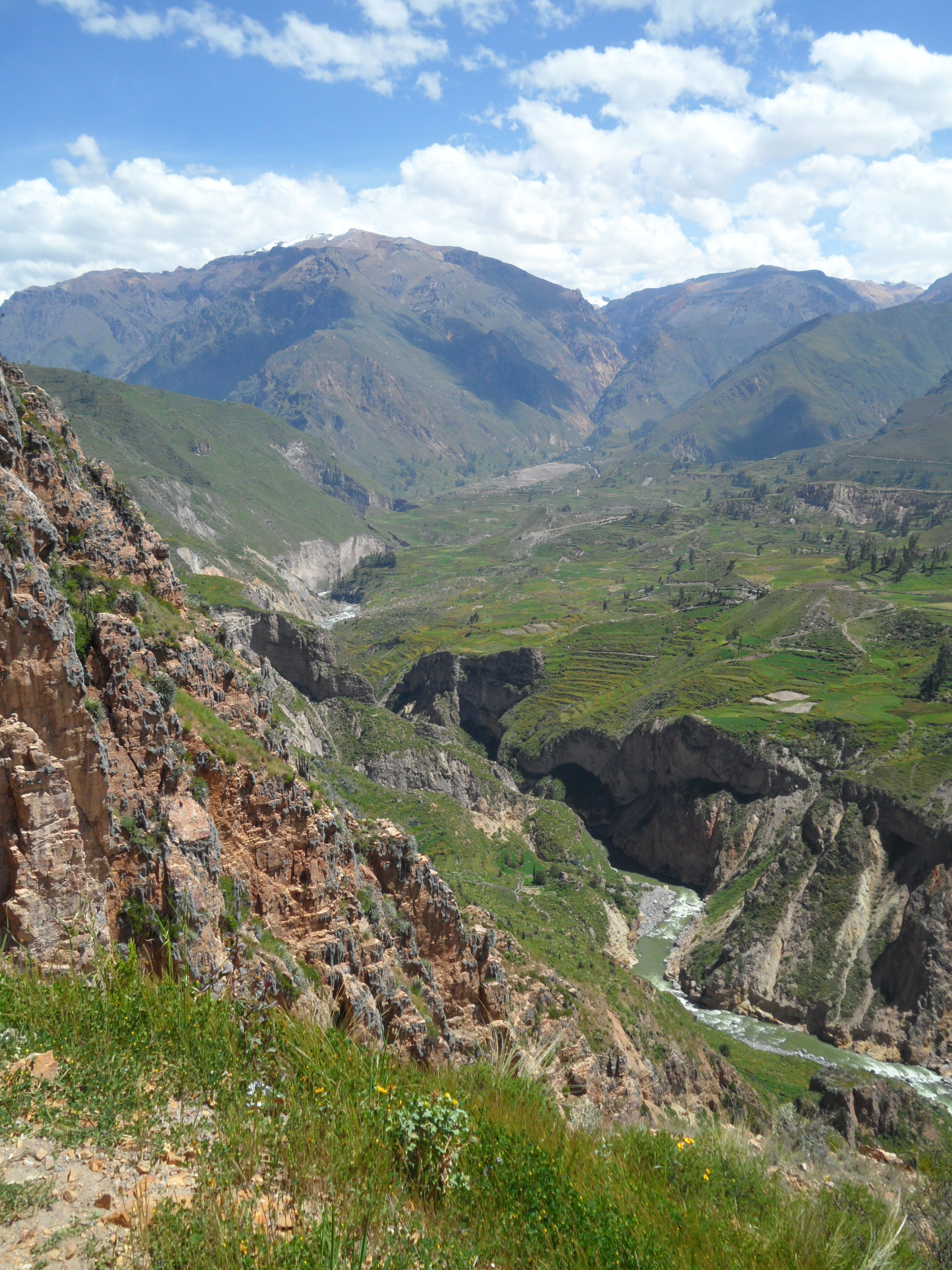
The two argued that the canyon was equal to, if not better than Machu Picchu. It is the second largest canyon in the world (the largest only a few more kilometers into the Andes) and is actually deeper than the infamous Grand Canyon itself. Needless to say, we went back to the hostel and immediately signed up for the next morning.

At 2:30am Sunday morning we heard a knock on our door. “Colca Canyon tour! Get up!”. We dragged ourselves out of a dead sleep and sped downstairs in record time: only to wait another 20 minutes for the bus to show up. 
The two of us tried to nod off during our three-hour bus ride to the canyon, but it was a bumpy road and the bus was freezing! Instead it was more of a nodding off here and there trying to curl up into the smallest ball possible for optimum warmth.

We were woken again at 6am where we all got off to have breakfast. I don’t know what the temperature was at the time, but it was deathly cold as soon as we got off the bus. You could see your breath and all the windows were fogged from the temperature change inside the bus. Breakfast was warm tea and bread crust with butter… That was it. Nobody was remotely satisfied when our tour guide pushed us all back on the bus 20minutes later. Not to worry, lunch was at 1:00, only 7 hours later!

From breakfast we went further into the valley towards the small town of Chivay. The valley was beautiful in the morning sunlight. The place was so green, with thousands of man made, grass terraces stretching for kilometers down the mountainside towards the river at the base of the canyon. The taller mountains were snowcapped, and it was our first glimpse of snow in South America.

Chivay was a quaint little village, full of busy locals herding alpacas and selling their wares to tourists. The women wore all their traditional garb of intricately decorated clothing: thick, billowing skirts, long sleeved blouses with a vest over top, a colourful hat, and their hair in two long braids that were pinned together at the ends in the middle of their backs. Their clothing consisted of EVERY colour under the sun. No care was taken to make sure colours matched or clashed; the detailed stitching was so busy and had so many shades of colour that the outfit was simply exquisite.  Some women danced the traditional “danza watiti” or the “dance of love” in the town square, while others held out giant falcons and adorable alpacas for the tourists to fawn over.

After a short time in Chivay, exploring a couple cathedrals and watching the locals, we continued on towards the Canyon’s deepest point. We passed through Yanque, and a couple other small villages on our way, but mostly it was just open expanses of valleys and mountains. No pictures or words could do this place justice. It was breathtaking in every sense of the word. Morning light is by far the best time to see the canyon, because of the contrasting shadows and sunlit spots across the horizon. Even with the villages the place felt remote. There were no large cities or factories; the people still worked the land by hand, walking for miles to reach the different terraces. They all moved about by foot or on mules, and the only vehicles around were the tour buses.

People of all ages walked up along the dirt road towards the top of the canyon. At one stop, we observed this little, old, hunched over lady with no teeth, shuffling her way up the hill. The closest town was kilometers away, so she must have been walking from there. Adam turned to me and said “look Hil, if a 95 year old woman can hike up this hill, surely you’ll have no problem on the Inca Trail next week”. We laughed, but found out afterwards that the woman wasn’t 95… Turns out she was 104 years old, and she hiked up and down that hill for kilometers EVERYDAY to beg for money at the top of the hill. OH MY GOD! On top of that, she wasn’t even the oldest person in the area! There was another woman in the next town over that was 111 years old. Unbelievable!

It took about an hour, but our bus finally reached the viewpoint for the deepest part of the canyon. The canyon was beautiful, with sheer cliffs of green and grey mountain across from us, and a valley so deep that the massive river at the bottom looked completely still, and no larger than a stream. We sat on the edge of a rock wall with our feet dangling over the edge of the canyon for over an hour just soaking up the view. While we sat, a massive Andean Condor floated by the crowds of tourists. This was a common nesting place for the birds, and although there are not many left in the world, seeing them in the Colca Canyon is apparently quite common. Andean Condors are the largest bird on Earth, and their wingspan reaches over 3 meters wide. The birds don’t flap their wings, but instead, float along the thermal air, reaching extreme heights and depths without moving so much as a muscle. The bird did a couple rounds of the area, at one point getting very close to the crowds as if to show off it’s enormous size. We were at a lower lookout, but even from where we were sitting, we could hear the crowd gasp all at once as the bird flew by them.

Eventually, it was time for lunch. We had a huge buffet lunch in town that included all sorts of traditional Andean foods like stuffed peppers and alpaca meat (which is tender and delicious, albeit a little gamey). When we had all finished lunch it was time to start heading back towards Arequipa. It was perfect timing really, considering we had perfect weather all day, and as soon as we stepped out of lunch it began to rain. We started our assent out of the canyon towards the main highway. At one point we reached the highest pass on the bus at an altitude just shy of 5000m (by far the highest point of altitude I’ve ever been at!) Our tour guide asked if we wanted to get off to take photos, but at this point it was snowing and hailing outside, and the view was obsolete from the fog. So we trekked onwards.


When we reached Arequipa it was going on 5:00 in the evening. Total time on the tour: 14 hours!! We were exhausted to say the least! We had a quick dinner and an early night, as we had fun things planned for the next morning already!

The Nazca Lines: Spoiler Alert – Aliens Not Involved

Because our bus from Ecuador turned out to be 2 days longer than expected, we only had 24 hours to spend in Nazca: we weren’t about to waste one second of it. We had a crazy, whirlwind day and booked 3 separate tours to get as much in as possible. The day was so full I’ve been apprehensive about writing about it… But here we go.

We really lucked out when we arrived at the Nazca, Cruz Del Sur bus station. A young man named Reynaldo had offered to drive us to our hostel for next to nothing, and on the way he explained that he did private tours of the city. His prices were equal to, or cheaper than the others we had checked out, so the three of us put together a full day excursion starting at nine AM the next morning. It was a great feeling going to sleep with everything taken care of!

The next morning we were picked up by a bus and taken to the airport just outside the city. We were going to go on a 35-minute flight in a tiny 4-passenger plane to see the Nazca Lines!! We were both so excited, and a little nervous. We’ve heard horror stories of some of the flights, with people throwing up all over the place from the turbulence. Even when we booked our flight the guy said, “don’t eat breakfast… Trust me”.  So we did as we were told, and I popped a gravol as an extra precaution.

We were very lucky in our wait time. Even with a reservation, many people wait between 1 and 4 hours to actually get on a flight. It all depends on weather conditions and number of tourists. We were weighed in and sent out to the runway within five minutes of arriving. The day was beautiful and HOT. There’s a reason they call this place Death Valley. The heat is outrageous, and the rainy season is a total of THREE HOURS a year!  
We packed ourselves into the little plane with two other guys, our pilot and our copilot. Our headsets were connected to the copilot’s so he could explain what we were seeing, and we were given a small map of the shapes. Then just like that we took off!  
I had never been in a plane that small before, but the experience was awesome! We must have hit a great day, because we had no turbulence and neither of us felt sick at all (thank god).

The Nazca lines tour was out of this world!! What a cool way of seeing them! We flew over each geoglyph twice, once on the right and then again on the left to take photos. The whale, the astronaut (actually the ancient priest), the hummingbird, monkey, parrot, spider, trapezoids, heron, dog, the tree and the hands! They were just like you see them in photos in magazines! They are perfect shapes with distinct lines and although it was sometimes a little hard to find them at first, once you saw one, you couldn’t not see it! They were beautiful and mysterious and we loved every second of the tour! From the air you could get a perfect view of the entire valley. Long lines zigzagged across it, and the shapes were scattered across the flats and along the sides of mountains. The area was desert, all shades of brown with gorgeous and surreal looking mountains off in the distance. Even as we looked at them, we both said that they looked more like a painting than real life. But the real spectacle was the lines. They ranged from 36m from end to end (the whale) all the way to 300m (the heron) As we found out later, these shapes were just a few main ones. There are over 200 figures, and 4000 lines in Death Valley, all made by the ancient Nazca people.

The flight was a great way to start our day, it was an exhilarating rush, and the lines were beautiful and exotic! Luckily, however, our next two tours with Reynaldo were full of information. If you go to Nazca, I recommend both tours. The lines are seen the best from the sky, but you get no practical information on them at all. When we met up with our guide after the flight is when we really started to understand what we were looking at..


The Nazcans were an ancient culture that lived prior to the better-known Inca’s, between 400BC and 800AD. They were a highly advanced civilization, and were well versed in mathematics and astronomy. They knew the pattern of the sun, the solstices, and even managed to map out the largest astrological clock ever to exist. These were the people that created the Nazca lines.  
Interestingly, the lines are not trenches dug into the ground, or painted rocks. They are actually just negative space. The Nazca people created lines by moving the dark pebbles of the canyon and revealing the lighter sand beneath. When many of the rocks are removed it creates a distinct, light coloured line by contrast… And they are EVERYWHERE throughout the valley! The lines were used for many things. Some denoted a path into the mountains, others were markers to mark the seasonal solstices, and some were images of animals meant as sacrificial offerings to the gods (ie the now famous Nazca lines).

We stood on one hill later in the day to take a look at the lines for the movement of the sun. The lines started at the hill, and stretched out in a perfectly straight line for as far as you could see into the distance. There were so many of these lines zig zagging across the valley, each one having its own special meaning or purpose. These formations of lines are considered to be the largest astronomical clock that exists: and I don’t know how you could possibly make one larger! 
The lines were discovered in the early 1930’s when the first aircrafts began to fly over the area. The figures were much darker than they are today. Over hundreds of years of being exposed to sun, the light coloured sand had darkened, making much less contrast between the two colours. It was not until a decade or so later, when Maria Reiche, a German-born Mathematician and archeologist, came to study the lines that things changed. Maria took it upon herself to restore the Nazca lines herself. She lived in the desert completely alone for 15 years and spent everyday cleaning the lines with a broom, and slowly mapping out each one of the geoglyphs. She was the person who introduced the lines to the public, and eventually made the movement to have the lines become a unesco world heritage site. Without her, the lines would have been destroyed today. Strangely enough, one of the geoglyphs is of a pair of hands. No one knows why hands were sculpted as a gift to the gods, and even stranger yet, why one of the hands only has 4 fingers on it. By coincidence, or fate, Maria Reiche had actually lost a finger when she was a young girl. She also only had 9 fingers. When she discovered the pictograph, she took it as a sign that restoring the lines was her duty from God; and so that’s what she did! After her 15 years of solitude, she spend the last 26 years of her life educating the world on the Nazca lines, until she finally passed away in 1998 at the age of 95.

Today, her house has been transformed into a museum. You can still see her charts, photos and work space exactly as she left it. She was meticulous in her studies, and has left behind invaluable information on the Nazca history. Unfortunately, without Maria around, there is no one to continue cleaning the lines, without funding and support from the government, the lines will eventually disappear if they are not properly maintained. It seems like such a shame.
  We got a tour of Maria Reiche’s house, a ground view of a couple of the lines from two separate miradors (man made scaffolds that you could climb to see the lines from above). And a close look at the astronomical clock… As one tour.

For our other tour we took a look at the Nazca Aqueducts. And as everybody knows, our guide told us, “these are the key to the Nazca lines”. Really? Because I’m pretty sure we thought it was aliens right up until 12 hours ago. Our guide was pretty funny and had this way of saying “of course!!” after every question we asked as if the answer was SO obvious! But I suppose in a way he was right about the aqueducts; without them there could be no civilizations living in Nazca, and so, they were extremely important to its history. Essentially, the Nazca people discovered two water sources under ground that they used to their advantage. They build incredibly long and elaborate aqueducts that led all through the valley in order to irrigate the land, thus creating fertile land to live on. They used gravity to their advantage to move the water in the right directions. The aqueducts went on for kilometers throughout the valley, with watering holes used for drinking, and others for bathing. Without these water sources, Death Valley would have been impossible to survive in. Hot temperatures and no rain all year round were not ideal conditions for a thriving civilization. And so, with the ingenious nature of the Nazca people, huge irrigation systems were created.

The Inca people, who came after the Nazcans, also used these systems. They used the aqueducts to their advantage when they set up strategic fortresses along the mountain ridge at the edge of the valley. We walked through the remains of the Inca fortress as well on the tour. It was interesting to see the difference between the two cultures. The Nazcans were concerned with irrigation and astronomy, mathematics and religion. Their reign was over 1000 years. The Inca reign was only 120 years! They were a warrior people, and were more focused on building strongholds against invading armies than culture. It’s amazing to see what they accomplished in such little time. 120 years to conquer so much land and to build empires that included grand fortresses like the one in Nazca, and Machu Picchu further inland.

Overall, the day was incredibly informative. We even learned a little about Nazcan pottery on the trip. One man had dedicated almost his whole life to studying the techniques of their ancient pottery. Today, his daughter continues his work, and creates the most amazing collection of traditional bowls, teapots, masks and figurines in a small house in Nazca. All the techniques are traditional, right down to the ancient kiln, and creating a shiny finish to the pottery by polishing oil from your face onto the finished product. Her work was exquisite! All in all, it was our first introduction to ancient Peruvian civilizations on the trip and I definitely learned a lot. I can’t believe we hadn’t even been in the city 24 hours and we were already heading out on yet another night bus to Arequipa. Then we were ready to spend 3 full nights doing nothing important before heading to Cusco and the Inca trail…